

How to Start a Painting Business: The Complete 2026 Roadmap
Most painters who start a business already know the trade cold. You can cut a clean line, run a sprayer, and prep a room without thinking twice. What you're really starting is the business around the trade. The good news for painters: this is the most accessible trade to start, with the lowest equipment cost of almost any. The catch: there's a real federal lead rule you have to follow, and an insurance gap that catches new painters off guard. Get those right and you're off and running.
The field is huge. The U.S. Bureau of Labor Statistics counts about 342,200 painters working in 2024, with employment projected to grow 4 percent through 2034 and about 28,100 openings every year. The median painter earns $48,660 a year. The U.S. painting industry is worth about $49 billion in 2026 according to IBISWorld, spread across roughly 231,544 businesses. It's a big, steady market, not a gold rush, which means the painters who run a real business (clean prep, clear pricing, professional systems) stand out fast.
This guide walks through every step of starting a painting business, in the order things should actually happen. Not theory. Not a list of "things to consider." A roadmap, from your license to your first booked jobs and beyond. Maybe you're a painter going out on your own. Maybe you're building a crew from scratch. Either way, this is the order to do it in.
1. Decide What You're Offering (and Who You're Serving)
Before you buy a single brush, get clear on the work you want to do. "Painting" covers a lot of ground, and the work you pick shapes your equipment, your pricing, and your marketing.
The common service lines for a new shop:
- Interior residential (walls, ceilings, trim, doors), the bread and butter and easiest to start
- Exterior residential (siding, trim, decks), higher-ticket and more weather and prep dependent
- Cabinet refinishing (a high-margin, skill-heavy niche that's in demand)
- Specialty finishes (faux, fine finishes, epoxy floors) for premium pricing
- Commercial (offices, retail, property management) for volume, usually once you have a crew
Most one-person shops start with interior residential repaints, add exteriors, and grow into cabinets, specialty work, or commercial from there.
Pick your customers
Residential repaints are the easiest entry point. Homeowners pay on completion, the jobs fit a small crew, and the work is steady. Commercial and property-management work pays well per contract, but it runs on net-30 billing and tighter schedules, so it needs working capital. Build a cushion before you chase the big accounts.
Set your pricing
Painting is usually priced by the job, based on square footage, surfaces, prep required, number of coats, and paint quality. The thing new painters underestimate is prep. The painting itself is fast; the labor is in the masking, patching, sanding, and protection. Price the prep, not just the paint. Underpricing is the fastest way to go broke, because a job you underbid still takes all day. Price to cover your time, your materials, your overhead, and a real profit. For a deeper look at setting rates that hold up, read what painting contractors actually charge and how to set your rates.
2. Get Licensed and Lead-Safe Certified (This Is the Gate)
Painting has a lighter licensing burden than most trades, but it has one rule that trips up new owners more than any other: the federal lead rule. This step is the gate.
State licensing comes in three buckets
Painting licensing is set by each state, not the federal government, so it varies widely. It generally falls into one of three buckets:
- A specific painting license. Some states issue a dedicated painting classification. California, for example, requires the C-33 Painting and Decorating license from its Contractors State License Board for jobs at or above $1,000 (a threshold raised from $500 in 2025), with a trade exam, four years of experience, and a $25,000 bond.
- A general contractor license that covers painting, with no painting-specific credential.
- No state license at all, where painting is regulated only locally. Texas, for instance, has no state painting license, though you may still need a local registration and you still register your business with the state.
Many states only require a license once a job crosses a dollar threshold, commonly somewhere in the $500 to $2,500 range. Because this varies so much, look your state up directly through the NASCLA directory of state contractor licensing boards rather than trusting a blog.
The EPA lead rule applies in every state
This is the one that catches people. Under the EPA's Renovation, Repair and Painting (RRP) Rule, any firm paid to disturb painted surfaces in a home, child-care facility, or preschool built before 1978 must be EPA Lead-Safe certified. This applies to sole proprietors too, and there's no way around it: lead-based house paint was common before it was banned in 1978, and disturbing it without lead-safe practices is a health hazard the EPA enforces hard.
Two pieces:
- Firm certification: Your business applies to the EPA. It costs $300 and is valid for five years.
- Certified renovator: At least one person on each covered job must complete an EPA-accredited 8-hour course (it includes a hands-on component) and run lead-safe work practices. The certification lasts five years.
The rule kicks in when you disturb more than 6 square feet of interior or 20 square feet of exterior painted surface in a pre-1978 building. Violations carry steep federal penalties, assessed per violation per day, so this is not a corner to cut. A handful of states run their own version of the program, so check the EPA RRP program page for whether you certify through the EPA or your state.
Check your state. Seriously.
Go straight to the source:
- Your state contractor licensing board, via the NASCLA directory
- Your Secretary of State to register the business, via the SBA's registration guide
- The EPA RRP firm certification page for the lead rule
3. Make It Legal: Your Business Entity
Once your licensing and lead-safe path is clear, set up the business itself.
Choose your structure
For most painters going independent, it comes down to two options:
- Sole proprietorship: The simplest. You and the business are the same legal entity, and you report income on a Schedule C. The catch: if the business is sued or runs up debt, your personal assets are exposed.
- LLC (Limited Liability Company): Costs $50 to $500 in state filing fees and builds a legal wall between your business and your personal finances. For a few hundred dollars, it's cheap protection in a trade where a spilled bucket or a botched job can mean a claim.
An LLC is usually worth the small upfront cost.
Get your EIN
An Employer Identification Number is free from the IRS. Apply online at irs.gov and you'll have it in minutes. You need it to open a business bank account, hire employees, and file taxes.
Register your business name
If you're operating as anything other than your legal name, file a DBA ("Doing Business As") with your county or state, usually $10 to $50.
4. Get Insured and Bonded
Insurance is cheap for painters compared to most trades, but there's one gap you have to understand, because it's the most common painter claim and standard policies often don't cover it.
Here's what a painting business typically carries, with rough costs from insurance marketplaces Insureon and Simply Business:
- General liability: Covers third-party property damage and injury (a ladder through a window, paint on a hardwood floor). Painters pay roughly $47 to $59 per month on average, and it's the policy clients ask to see.
- Workers' compensation: Required in nearly every state once you have employees. Roughly $184 to $239 per month for a small crew, scaling with payroll.
- Commercial auto: For the van, about $139 per month on average.
- Tools and equipment coverage: Cheap, roughly $14 to $21 per month, covering sprayers, ladders, and hand tools.
- A surety bond: Required by many states to hold your license, with the premium running about 1 to 5 percent of the bond amount (often around $100 a year).
The overspray gap
Here's the one to understand. Overspray is the classic painter claim, and standard general liability often does not cover it. When airborne paint from a sprayer drifts onto a neighbor's car, building, or landscaping, most GL policies treat it as a pollutant and exclude it under the pollution exclusion. A single overspray-on-cars claim can run well over $20,000, out of your pocket. If you spray, especially exteriors, you typically need a separate Contractors Pollution Liability policy, which runs about $1,800 to $5,000 a year. Ask your agent about it directly, because finding out after an overspray claim is an expensive way to learn this.
5. Set Up the Money Side
You're a business now, so money has to move through the business, not your personal account.
Open a business bank account
Use your EIN to open a dedicated business checking account. It keeps your books clean, makes tax time bearable, and preserves the legal separation your LLC gives you. Run every dollar of revenue and every expense through it.
Decide how you get paid
A few habits to set from day one:
- Take a deposit on larger jobs so you're not buying paint out of your own pocket.
- Bill the balance on completion, after the final walkthrough.
- Make it easy to pay, with card payment built into your invoice so you collect on the spot.
Because paint is a per-job cost (usually 15 to 25 percent of the job price) rather than a big upfront inventory buy, painting stays cash-flow friendly if you collect deposits and bill on time.
6. Buy Your Tools and Equipment
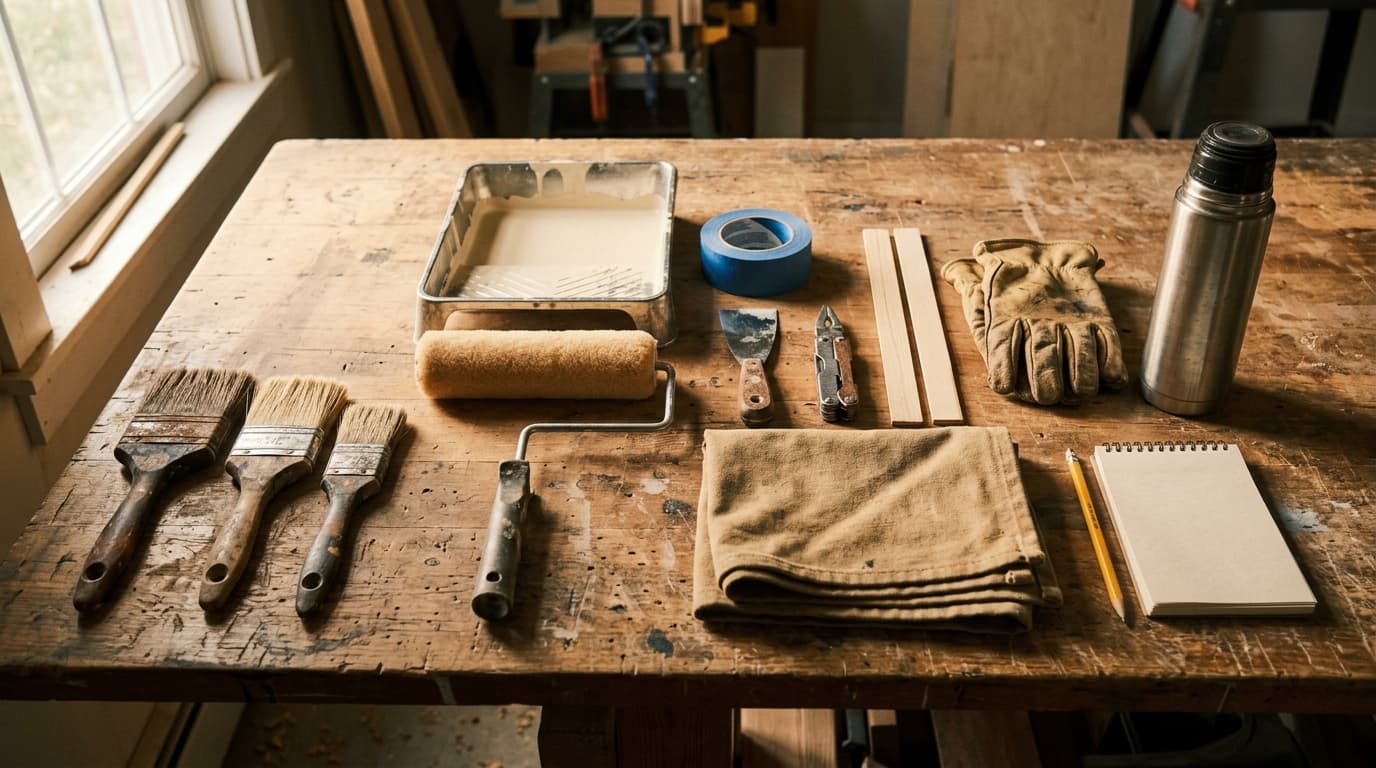
This is the best part of starting a painting business: it's cheap. A solo painter can get going for as little as $500 to $2,000 in tools and insurance, where most trades need $10,000 or more just to start. A fuller launch with a small crew and better equipment runs up to about $15,000. Here's where the money goes:
- Brushes, rollers, frames, and poles: Quality hand tools run $300 to $1,000. Buy good brushes, they pay for themselves.
- An airless paint sprayer: The marquee upgrade. A homeowner-grade starter sprayer runs $300 to $800; a true professional residential workhorse like the Graco 390 runs around $2,710; high-end rigs go higher. This is the tool you buy once revenue starts, not necessarily on day one.
- Ladders and scaffolding: A solid ladder runs $100 to $500, more if you add scaffolding for exteriors.
- Drop cloths, masking, and prep supplies: $50 to $500, the unglamorous gear that protects the customer's house and your reputation.
- A pressure washer for exterior prep, $100 to $1,000 depending on electric or gas.
- A work van: Optional and the biggest swing factor. A used van runs $3,000 to $8,000. Many painters start with the vehicle they already own.
Paint and materials are per-job costs you buy as you book work, which is exactly why painting startup costs stay low.
7. Build Your Brand and Web Presence
People hire painters they trust, and the work is visible, so trust comes fast once you have proof. You don't need a flashy brand. You need to look like a real, findable, professional business.
- A business name and logo that's clean and readable on a van, a yard sign, and a business card.
- A domain name. Register one (your business name dot com if you can get it) through a registrar like Namecheap or Cloudflare. It's usually $10 to $20 a year.
- A professional email at your domain (you@yourpainting.com), not a personal Gmail.
- A simple website with your services, service area, photos of finished work, and a way to request an estimate. If building and maintaining a separate site sounds like a chore, Bit & Grain gives you a business website and a self-booking page where customers can request an estimate directly, tied to the same system you run jobs from.
If you want to see how Bit & Grain is built for the trades, including painting, take a look at the painting page.
8. Set Up Your Operations System
This is where new painting businesses quietly bleed money. You're great with a brush. But you're also now estimating jobs, sending invoices, chasing payments, scheduling crews, and keeping records straight. A notebook and a text thread works for your first few jobs. It falls apart fast once you're juggling two crews, three estimates, and a customer asking where their invoice is.
Bit & Grain is built for exactly this stage: a solo painter or a small crew that needs estimates and invoicing, scheduling, job management, and payment collection in one place, without the complexity or the price tag of software built for big shops. It starts at $29 a month, and you can see the full pricing here.
Here's what your operations system needs to handle:
- Estimates: Send a clean, professional estimate before the work, with the scope and prep spelled out. The customer approves it in writing, and you've killed the "I thought that was included" conversation.
- Invoicing and payment: Bill the moment the job's done, with card payment and deposits built in.
- Scheduling and dispatch: Know which crew is on which job on which day, and when materials are landing.
- Job tracking: Notes and photos on every job. "Two coats, eggshell." "Customer wants trim semi-gloss." "Deposit collected." The details keep jobs and money straight.
Set this up before your first paying customer, not after you've lost track of who owes you what.
9. Get Your First Customers
You've got your license, your lead-safe certification, your insurance, and your systems. Now you need the phone to ring.
Google Business Profile (free, do this first)
Create a Google Business Profile. This is how you show up when someone searches "painter near me," and it's free. Add your service area, hours, services, and photos of finished work. For a local painter, this one listing will generate leads for years.
Show your work and get reviews
Painting is visual, so your work is your best marketing. Post before-and-after photos on social media and your profile. After every job, ask the satisfied customer for a Google review. Bit & Grain has a built-in review request tool that texts each customer a direct link after the job closes. A steady stream of five-star reviews and sharp photos will out-earn any ad you could run.
Referrals and trade relationships
Painting runs on referrals. Tell every customer you're taking new work. Build relationships with realtors (who need fast repaints before listings), property managers, remodelers, and interior designers. Those relationships become steady, repeat work.
10. Run Jobs Like a Pro
Booking the job is one thing. The painters who build lasting businesses are the ones who prep well, protect the customer's home, and finish clean.
Prep is the job
The difference between an amateur and a pro is prep. Mask and protect everything, patch and sand properly, and prime where needed. A great paint job is 80 percent preparation. Customers may not see the prep, but they see the result, and they see whether their floors, furniture, and landscaping came through untouched.
Communicate and document
Confirm the date, send an "on my way" message, and keep the customer posted. Bit & Grain's client portal gives each customer a place to see their estimate, schedule, and invoice, and two-way texting keeps the back-and-forth in one thread instead of your personal phone.
Handle scope changes and finish clean
"While you're here, can you also do the hallway?" That's a change order, not a freebie. Quote it, get approval, and add it to the invoice. Service logs and change orders keep the scope and price honest. End every job with a walkthrough: walk the customer through the work, catch any touch-ups on the spot, and clean up completely. That final impression is what earns the review and the referral.
11. Track Your Money and Stay Ready for Taxes
This is the step most new owners ignore until April, then panic. Don't be that painter.
Track every expense
Paint, supplies, fuel, the van, insurance, your phone, software. Every legitimate business expense lowers your taxable income, but only if it's recorded. Bit & Grain's receipt scanning lets you snap a photo of the ticket right at the paint store counter. It's logged and categorized for tax time, no shoebox of crumpled receipts in January.
Track your mileage
Painters drive constantly: to the paint store, between jobs, to estimates. Every business mile is deductible at the IRS standard mileage rate, which the IRS sets each year (it was 70 cents per mile for 2025). Those miles add up to real deductions you don't want to lose. Mileage tracking logs it automatically.
Pay quarterly estimated taxes
As a self-employed owner, nobody's withholding taxes from your pay. You owe self-employment tax of 15.3 percent on your net earnings, on top of income tax. If you'll owe more than $1,000 at filing, the IRS expects quarterly estimated payments (roughly mid-April, mid-June, mid-September, and mid-January) using Form 1040-ES. Skip them and you'll eat penalties. A safe habit: set aside 25 to 30 percent of every dollar of profit for taxes the moment it lands.
Know your real numbers
At the end of each month, look at what came in, what went out, and what's actually left. Bit & Grain's financial reporting gives you that picture without an accounting degree. Painting margins commonly run 10 to 30 percent, but only if you price the prep and watch your costs. Knowing your real numbers is what keeps you in the healthy end of that range.
12. Grow
Once you're consistently booked and profitable, it's time to scale on purpose.
Build and keep good crews
Painting is a people business, and a reliable crew that preps well and shows up is your real asset. Bring in subcontractors for overflow, and grow your own lead painters as you add crews.
Move into higher-margin work
Add the niches that pay more: cabinet refinishing, specialty and fine finishes, and commercial accounts. These command premium pricing and face less competition than basic interior repaints.
Add recurring revenue
Build relationships with property managers, realtors, and commercial clients who need repaints on a regular cycle. Recurring, repeat work smooths out the seasonal swings and is worth far more than chasing one-off jobs.
Raise your prices
After a year of reviews, photos, and a real track record, you've earned the right to charge more. The customers who value clean prep, careful protection, and a crew that shows up won't leave over a few dollars. The ones who do were probably your least profitable jobs anyway.
The Bottom Line
Painting is the most accessible business in the trades. You can start for a few hundred dollars in tools, the demand is everywhere, and your finished work sells the next job for you. The trade knowledge you already have is the hard part. The business around it is learnable, and this roadmap is the order to learn it in: get licensed and lead-safe, get legal, get insured (mind the overspray gap), set up real systems, and treat it like a business from day one.
Bit & Grain handles the business side so you can stay focused on the work: estimates, invoices, scheduling, payments, change orders, expenses, and client communication, built for the trades and priced for a one-person shop. Start free today and see how it works.
You already know how to paint. Now go build a business around it.