
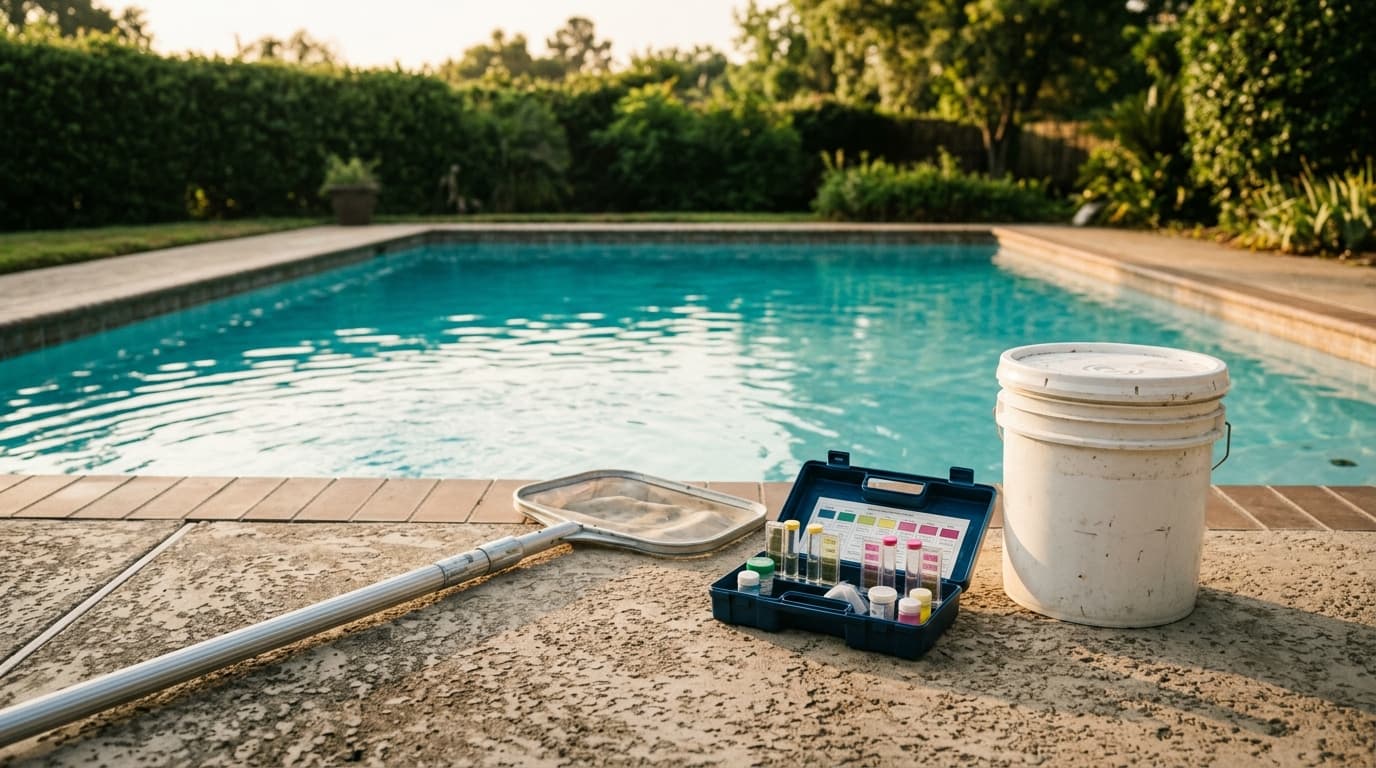

How to Start a Pool Service Business: The Complete 2026 Roadmap
If you can balance a pool, you already know the hard part of this trade. You can read a test kit, tell algae from pollen at a glance, and fix a cloudy pool before the homeowner's party on Saturday. What you probably haven't done yet is run the business around it. That's a different skill, and it decides whether you're running your own route in three years or still working for someone else's.
Here is why the numbers work. Leslie's, a national pool supply retailer, says in its fiscal 2025 annual report that the U.S. has about 9.0 million residential pools and a $15 billion pool and spa care industry. The company puts done-for-me services at about 35 percent of residential pool care spending. That's somebody like you. Every one of those pools needs water testing, chemicals, and cleaning on a schedule, whether the economy is up or down. That is recurring revenue, and recurring revenue is what makes a small route worth building.
This guide walks through how to start a pool service business in the order things should happen, from your certifications to your first twenty stops and beyond. Anything that changes by state, I'll point you to the official source instead of guessing.
1. Decide What You're Selling (and to Whom)
Pool service sounds like one job. It's really a few, and they pay differently.
- Weekly service is the backbone. You show up on the same day each week, test and balance the water, skim, brush, vacuum, empty baskets, check the equipment, and leave a record. It pays less per visit than one-off work, but it repeats. A full route of weekly stops is a business.
- Openings and closings are seasonal jobs in colder states. You open the pool in spring and winterize it in fall. Customers pay a flat fee, and the work lands in a short window.
- Green-to-clean is the recovery job: a pool that turned green while the owners were away or the equipment was down. It's hard, dirty, and billable by the hour plus chemicals.
- Equipment and repair work (pumps, filters, heaters, salt cells) pays the most per hour. It is also where licensing gets serious (Step 2).
Most new owners start with weekly service plus openings, closings, and the occasional green pool. Add repair once you're licensed for it.
Residential or commercial?
Start residential. Homeowners decide fast, they pay by card, and one person can service a backyard pool. Commercial pools (apartment complexes, HOAs, hotels, gyms) bring bigger accounts and tighter rules. Many health departments oversee public and commercial pools and expect a certified operator, and those clients often ask for proof of insurance and written documentation. Take those accounts once your paperwork is clean.
2. Get Certified and Check Your License
This step changes the most from one state to the next, so read it slowly.
CPO certification: the one most people start with
The credential you'll hear about first is the Certified Pool & Spa Operator (CPO), run by the Pool & Hot Tub Alliance (PHTA). PHTA presents it as the standard credential for commercial pool and spa management, says the program helps operators meet local health code, and offers courses in person, virtual, or blended.
Some facts straight from PHTA's recertification page:
- A CPO certification is valid for five years from the end of the month it was issued. Issued March 2, 2025? It expires March 31, 2030.
- If your certification is still active, you can renew by taking the second day of a CPO course, which includes a review of day one, jurisdiction updates, and the exam.
- If it has expired, you take the full two-day course again.
What does it cost? ServiceTitan's startup cost guide lists CPO certification at about $415 to $515 where it's required. Prices vary by instructor, so check PHTA's course finder.
Is it required? Often for public and commercial pools, sometimes not for private residential service. Local health departments set the rule. For example, Washoe County, Nevada requires operators of public pools to complete a PHTA CPO course. Your county might say something different. Call and ask.
Even if nobody makes you, I'd take the course. You learn the chemistry behind what you do, you can put "CPO certified" on your truck and website, and commercial managers notice.
State licensing: check your state
There is no single national pool service license. The rules sit with your state, and sometimes your county or city. Here's what I could verify.
- Cleaning and chemicals often sit on one side of a line. Repair, equipment, and construction sit on the other. Regulators watch that line closely.
- Florida is a clear example. The state's DBPR construction industry page lists a "Swimming Pool/Spa Servicing Contractor" license for servicing and repair work. It says installing, modifying, or replacing equipment permanently attached to a pool or spa for water treatment or cleaning requires a license, while simply using that equipment does not.
- California licenses pool work through the Contractors State License Board. Its C-53 classification covers swimming pool construction. If you plan to do anything beyond cleaning and chemicals there, call CSLB and ask exactly where service ends and contracting begins.
- A trade-press report from Pool & Spa News (dated 2011, so treat it as background) noted that several states, including Florida, Texas, and California, license techs who do more than clean.
I won't tell you your state's rule, because rules change and I'd be guessing. Here is how to find it in an afternoon:
- Search "[your state] swimming pool contractor license" and "[your state] pool service license." Read the board's own page.
- Call your state contractor licensing board and ask: "I'm going to clean pools and add chemicals. Do I need a license? What if I replace a pump or a filter?"
- Call your county health department and ask about commercial pool requirements.
- Check the SBA's licenses and permits page for the federal, state, and local layers, and your city for a general business license.
Write down what they tell you, with the date and the name.
3. Learn Chemical Safety Before You Carry Any
Chemicals are the dangerous part of this trade. Treat them that way from day one.
The CDC's report on pool chemical injuries estimates that about 4,876 people went to an emergency department in 2012 for pool chemical injuries, and 46.9 percent of patients were under 18. Among the poisoning cases, 92 percent came from breathing vapors or gas, not swallowing anything. The CDC's report ties the injuries to a few causes: people handling chemicals without protective gear (especially when opening containers), chemicals added to the water just before someone swims, and chemicals stored where kids can reach them.
The CDC's advice is plain:
- Read the label and the Safety Data Sheet before you use a product.
- Never mix chlorine products with acid. It can create toxic gas.
- Open one container at a time and close it before you open another.
- Wear goggles, gloves, and a respirator, and keep kids away while you handle chemicals.
I'd add a few habits. Keep every chemical in its original container with the label on. Store chlorine products away from acids and fuel. Keep lids tight. And never reach into a bucket with a wet scoop.
If you have employees: OSHA's Hazard Communication standard
The moment you hire someone, you take on workplace duties. OSHA's Hazard Communication page says employers with hazardous chemicals in their workplaces must have labels and safety data sheets and must train workers to handle those chemicals appropriately. Keep a binder or a folder of SDS sheets for every product you carry, and make sure your crew knows where it is.
Moving chemicals in your truck
You'll haul chemicals every day, and federal transportation rules apply to them. Here is what the federal code says.
- Trichlor and calcium hypochlorite are classified as Class 5.1 oxidizers, and liquid chlorine (hypochlorite solution) and muriatic acid (hydrochloric acid) are Class 8 corrosives, according to NOAA's CAMEO Chemicals database (see the entries for calcium hypochlorite, hypochlorite solution, and hydrochloric acid).
- Federal rules include a "materials of trade" exception built for contractors who carry small amounts of hazardous material in support of their business. Under 49 CFR 173.6, the total weight of all materials of trade on a vehicle can't exceed 440 pounds, and for oxidizers and corrosives in Packing Group II or III the limit per material is 66 pounds or 8 gallons (a Packing Group I oxidizer is capped at 1 pound or 1 pint). The packing group for each product is in the Hazmat Table at 49 CFR 172.101 and on the SDS. Each material has to stay in its original packaging (or something equally strong), closed, secured against shifting, leak tight for liquids, and sift proof for solids.
Do the math on your own truck. Five 50-pound buckets of trichlor is 250 pounds before you add liquid chlorine, acid, and the rest. If you carry more than the exception allows, different rules can apply. Check the current rule at the link above, contact PHMSA's Hazardous Materials Information Center or your state's motor carrier office, and ask your insurance agent how they treat chemicals in the vehicle.
4. Pick Your Business Structure
Sole proprietorship or LLC
- Sole proprietorship: The simplest. You and the business are the same legal entity, and you report income on a Schedule C. The risk: if something goes wrong, your personal assets are exposed.
- LLC: Filing fees vary by state (commonly $50 to $500) and it puts a legal wall between the business and your personal life. You handle chemicals around kids and pets, and an equipment mistake can flood a backyard. I'd want that wall. Keep it intact by running business money through a business account only.
Get your EIN and register your name
An Employer Identification Number is free from the IRS. Apply online at irs.gov and you'll have it in minutes. If you operate under anything other than your own legal name, file a DBA ("Doing Business As") with your county or state first. Check that the name isn't already taken in your state's business registry. The SBA's registration guide walks through the steps.
Also ask your state department of revenue whether any of your services or products are subject to sales tax. It varies.
5. Get Insured
Do not service a single pool without insurance. One chemical spill on a deck or one gate left unlatched can turn into a claim that ends a young business.
Insureon publishes average costs for pool and spa cleaning services. As of its September 2026 update:
- General liability: about $95 per month, with $1 million per occurrence and $2 million aggregate limits. This is the policy that covers property damage and injury claims from your work. HOAs, apartment managers, and licensing boards often ask to see it.
- Business owner's policy (BOP): about $81 per month, bundling general liability with property coverage.
- Workers' compensation: about $114 per month. Most states require it once you have employees.
- Commercial auto: about $250 per month. Your personal auto policy may not cover a truck loaded with chemicals and gear.
Those are averages from one marketplace, not quotes. Your price depends on your state, your revenue, and what you do. Get at least three quotes, and ask your agent these questions out loud:
- Does my policy exclude pollution or chemical release? Pool work involves chemicals, so this matters.
- Am I covered if I damage a customer's equipment, or if water damage follows my work?
- Can I add an HOA or property manager as an additional insured?
- Are my tools and test equipment covered in the truck?
Some licensing boards and commercial clients also want a surety bond. Whoever requires it sets the amount, so confirm it before you shop.
6. Set Up the Money Side
Use your EIN to open a dedicated business checking account. Run every dollar of revenue and every expense through it. It keeps your books clean and your LLC protection intact.
Pool service has one big advantage here: recurring billing. A weekly customer who pays on a card each month is predictable income. Set a policy from the first customer:
- Bill monthly in advance for weekly service. It beats chasing someone for last month's visits.
- Put a card on file and charge it automatically.
- Bill one-off jobs (openings, closings, green pools) at completion, with a deposit up front on bigger ones.
- Know your cold-weather picture. In states where pools close for the winter, your income stops while your insurance and truck payment keep going. Set aside part of each good month for the slow ones.
7. Buy Your Tools, Chemicals, and Truck
This is one of the cheaper trades to start. ServiceTitan's pool cleaning startup guide lists these ranges:
- Starting equipment: $500 to $3,000. Poles run $130 to nearly $1,000, and brush heads $30 to $50 each.
- Test kits: roughly $13 for a basic kit up to about $500 for a digital one.
- Work vehicle: a used van runs roughly $2,500 to $20,000 and a new one about $30,000.
- Parts and maintenance stock: the same guide suggests $500 to $2,000 for things like o-rings, baskets, and replacement parts.
ZenBusiness's startup guide (updated January 2026) lists similar ranges for registration, licensing, equipment, vehicle, insurance, and marketing. Add its low ends and you get roughly $6,650; add the high ends and you get about $31,500 (that's my math, not theirs). The vehicle is the swing factor. If you already own a reliable truck, you're near the low end. These come from business and software sites, so use them as a planning range and get your own quotes.
A few tips from the field:
- Buy a good test kit. Your readings are your product. A cheap strip that drifts will cost you a customer.
- Open a wholesale account at a pool supply distributor as soon as your volume supports it.
- Organize the truck. Chemicals in sealed, labeled bins, acid on one side, oxidizers on the other, nothing loose.
8. Set Your Rates (and Know What a Stop Costs You)
New owners underprice almost every time. They compare themselves to a neighbor with a pool net and a Saturday free, and they set the price too low to cover the truck.
What the market looks like
Thumbtack's pool maintenance cost guide puts basic pool cleaning at an average of about $86, with a range of $80 to $200, and says pool cleaners nationally charge about $60 to $90 per hour. For one-off work, it lists pool openings and closings at about $95 each on average (openings range from $85 to $350, closings from $85 to $500), and one-time cleanings outside a service contract at about $225. It also names the things that move a price: pool size, nearby trees and foliage, equipment condition, location, and whether the pool is indoors or out.
Those are homeowner price guides. Your market will differ, so use them as a sanity check, not a menu.
Price from your costs, not your nerves
Here's the simple way to price a weekly stop. These are example numbers to show the method, not a benchmark.
- Pick the dollars you need per hour on the route. This has to cover your truck, fuel, insurance, software, supplies, taxes, and your pay. Say it's $80.
- Count the time per stop, including the drive. Say 35 minutes at the pool plus 10 minutes of driving is 45 minutes.
- Price the time: 45 minutes at $80 an hour is $60.
- Add average chemicals for that pool. Say $8.
- Round up. That puts the stop near $70 a visit, and about $300 a month for weekly service (a month has about 4.3 weeks).
Now change one thing. A bigger pool under three oak trees takes 55 minutes on site and eats more chemicals. Your price should go up, not stay flat. That's why you price by pool size and conditions, not one price for the whole neighborhood.
Route density is the other lever. Ten stops on one street earn more per hour than ten scattered across a county, because drive time is unpaid. Before you quote a new customer, ask where they fall on your route.
For openings, closings, and green-to-clean, price by the job. Be extra careful with green pools. You can't see what's under green water until you've cleared it, so quote a base price, say plainly that heavy algae, a dirty filter, or equipment trouble may add to it, and take a deposit before you buy chemicals.
Our free business calculators, including a job profitability calculator, help you check your math before you quote a job. They cost nothing.
Put it in writing: the Pool Service Business Starter Kit
I put the paperwork together as the Pool Service Business Starter Kit, $49 one time. It includes a pricing calculator spreadsheet that prices weekly service by pool size, plus one-off jobs like openings and green-to-clean; an estimate and invoice spreadsheet; a recurring service plan form in Word and PDF that your customer signs; and a startup checklist covering licensing, certifications, chemical safety, insurance, and equipment. One payment, and the files are yours. If you'd rather build your own, the list above is what to build.
The service plan is the piece I'd never skip. It says which day you come, what's included, how chemicals are billed, what counts as extra (green pool recovery, equipment repair), how a customer cancels, and who handles the gate and the dog. Every one of those lines prevents an argument later.
9. Build Your Brand and Web Presence
People hire the pool person they trust, and trust starts online. You don't need a fancy brand. You need to look like a real business.
- A name and a simple logo that read clearly on a truck door, a shirt, and an invoice.
- A domain name. Register one through a registrar like Namecheap or Cloudflare. It usually runs $10 to $20 a year.
- A professional email at your domain (you@yourpoolcompany.com), not a personal Gmail.
- A simple website with your services, your service area, your certifications, and a way to request work. If you don't want to build and maintain one, Bit & Grain gives you a business website and a self-booking page where customers can request an opening, a closing, or a green-pool cleanup directly.
You can see how it all fits together on our pool service page.
10. Set Up Your Operations System
This is where a lot of new routes quietly lose money. A notebook and a text thread get you through the first five customers. At fifteen weekly stops and a customer asking what you found last Tuesday, they fall apart.
Bit & Grain is built for exactly this stage: one owner or a small crew who needs estimates and invoicing, scheduling, job management, and payments in one place, without the cost or the complexity of software built for big dispatch companies. It's $29 a month, Grain AI is included, and there's a 30-day free trial. Here's what your system has to handle:
- A route for each day. Route planning lets you build a single-day route across your appointments, which cuts windshield time and keeps you on schedule.
- A record of every visit. Customers ask, "What did you do?" Have an answer with readings. The service log lets you document each visit, including chlorine, pH, alkalinity, calcium, and equipment status.
- Estimates and invoices. Send a clean estimate for the one-off job, get the approval in writing, and invoice when the work is done. Customers can pay by card.
- Customer details. Gate codes, dog names, pump locations, the pool's volume, and the customer's preferences. These are the details that make you look like a pro instead of a guy with a net.
Set this up before your first paying customer, not after you've lost track of who owes you what.
11. Get Your First Customers
You've got your certification, your insurance, your truck, and your systems. Now you need the phone to ring.
Start with the neighborhood
Pool service is local. The best marketing is a dense route, so build one neighborhood at a time. Drop a flyer on every door near your first customer, and say you service the pool two houses down. Ask for referrals, and offer a small credit to the neighbor who sends one.
Google Business Profile
Create a free Google Business Profile. It's how you show up when someone searches "pool service near me." Add your service area, hours, services, your CPO certification, and photos of real work: a pool you just cleared, a tidy equipment pad, your truck.
Reviews
After every one-off job and every month or two on a route, ask for a Google review. A steady run of honest reviews beats any ad you could run. Bit & Grain has a built-in review request tool that sends each customer a direct link after the job closes, so you don't have to ask awkwardly in person.
Partners and bigger accounts
Pool supply stores, real estate agents, home inspectors, and property managers all get asked, "Do you know a good pool person?" Introduce yourself. Once you have references, approach small HOAs and vacation rental owners too. They take more paperwork but bring several pools at once.
Show your work
Before and after photos of a green pool turned clear are the best content in this trade. Post them on Facebook and Instagram. You don't have to be polished, just consistent. Bit & Grain connects to your social media accounts so you can schedule posts alongside your job workflow.
12. Run the Route Like a Pro
Winning the customer is one thing. Keeping them for years is the business.
- Show up the same day each week, and tell the customer when you're running late.
- Leave proof. A short note or a photo of the clear water and the readings. Most customers never see the pool being serviced, so the record is how they see your work.
- Handle surprises in writing. You find a cracked pump housing or a worn-out filter. That's not a freebie. Quote it, get approval, and add it to the invoice. Bit & Grain's change orders let you add the line items and have the customer sign on the spot.
The phone app helps here, and it's one download for iPhone, iPad, and Apple Watch: bitandgrain.app/ios. Open it once you're parked at the stop, log your readings, snap a photo, and move on.
13. Track Your Money and Stay Ready for Taxes
This is the step most new owners ignore until the spring, then panic. Don't.
Track every expense
Chemicals, test strips, fuel, tools, insurance, the truck, your phone, and software. Every legitimate business expense lowers your taxable income, but only if you recorded it. Bit & Grain's receipt scanning lets you snap a photo of the ticket at the pool supply counter once you're parked, and it's logged for tax time. No shoebox of faded receipts in January.
Track your mileage
A route means a lot of miles. The IRS business standard mileage rate was set at 72.5 cents per mile for 2026, then raised to 76 cents per mile for miles driven on or after July 1, 2026. At 76 cents, 100 business miles a week is $76 a week, close to $4,000 over a year. Mileage tracking in the iPhone app lets you tap Start Trip before you head out and End Trip once you're parked, so you're not guessing in December.
Pay quarterly estimated taxes
As a self-employed owner, nobody withholds taxes from your pay. You owe self-employment tax of 15.3 percent on your net earnings, on top of income tax. If you expect to owe $1,000 or more, the IRS expects quarterly estimated payments (roughly mid-April, mid-June, mid-September, and mid-January) with Form 1040-ES. A safe habit is to set aside 25 to 30 percent of every dollar of profit when it lands. Talk to a tax professional about your own numbers.
Know your real numbers
Once a month, look at what came in, what went out, and what's left. Bit & Grain's financial reporting gives you that picture without an accounting degree. Once you know your cost per stop, you'll know which customers are worth keeping and which ones to reprice.
14. Grow
When your week is full and the numbers are steady, grow on purpose.
- Fill the route before you hire. A tight route beats a big one. Add stops near stops you already have.
- Raise prices once a year. Chemical and fuel costs go up, and a small, announced increase is normal.
- Add services. Openings, closings, and green-pool recovery already bring one-off revenue. Salt cell cleaning, filter deep cleans, and, once you're properly licensed, equipment repair and replacement all raise what each customer is worth.
- Hire your first tech. When you can't fit another stop, hire someone you can train. Remember that an employee means workers' compensation, payroll setup, and OSHA training on the chemicals they'll handle.
The Bottom Line
Pool service is cheap to start compared to most trades, and the work repeats every week. The parts that sink new owners are the ones in this guide: guessing at the license rules, getting careless with chemicals, pricing a stop below what it costs you, and keeping no records. Fix those four and the rest is knocking on doors and showing up on the right day.
If you want help with the business side, Bit & Grain handles the routes, estimates, invoices, service logs, and receipts, built for the trades and priced for a one-truck shop at $29 a month with Grain AI included. Start your 30-day free trial and see if it fits.
You already know how to clear a pool. Now build a business around it.