
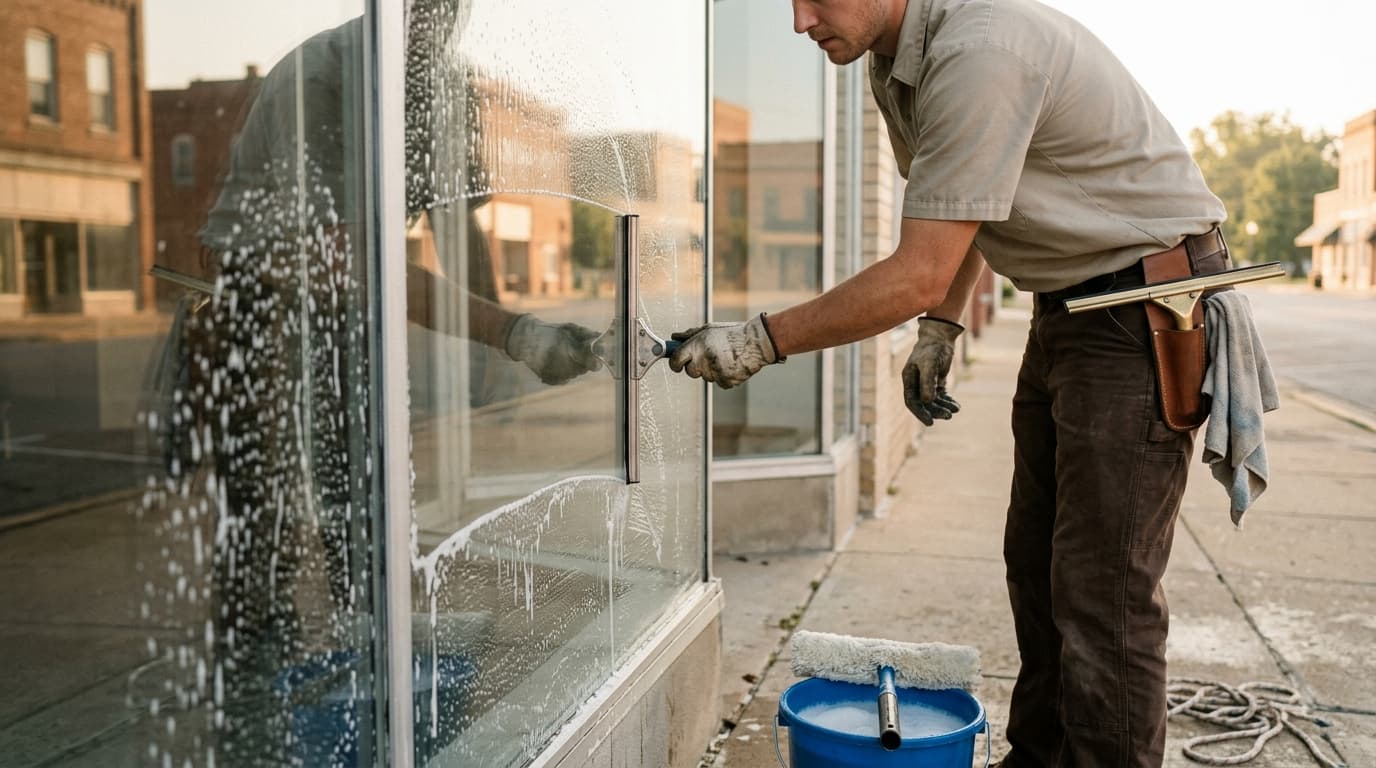

The big story in window cleaning right now is a robot. Searches for "window cleaning robot" are up more than 2,000 percent, and every trade feed has a clip of a little machine crawling across a pane of glass while somebody narrates the future.
Maybe someday. But if you actually run a window cleaning business, the robot is not the thing keeping you up at night. The thing keeping you up is the part no robot is going to touch: which route you run Tuesday, whether the Hendersons are due for their quarterly, what you should quote the new office park downtown, and which three invoices are still sitting unpaid from last month.
That is the boring part. It is also where the money is. And it is exactly what good window cleaning business software is supposed to track. Not the future. The Tuesday.
The US window cleaning industry pulls in around $2 billion a year, according to IBISWorld, spread across tens of thousands of small operators. Almost none of them are losing margin for lack of a robot. They are losing it to loose routes, soft quotes, and slow payments. So before you worry about the machine, get the basics onto a system you can actually see.
The robot gets the headlines. Your route sheet still pays the bills.
The tech is worth taking seriously, because some of it is genuinely good. Estimating, scheduling, reminders, voice assistants that let you log a job from the truck without typing: that is real, and it helps. We lean into it ourselves with Grain AI, because a window cleaner talking to their phone between stops is a lot more realistic than one sitting at a laptop at 9pm doing paperwork.
But automation only helps the parts of your business that are written down somewhere. A robot can clean a pane. It cannot tell you the strip mall on Route 9 is your most profitable stop, or that you have quietly gone six years without raising a price on a customer who would happily pay more. If that lives in your head and on a paper route sheet, no new gadget fixes it.
And a lot of it does still live on paper. Across the service trades, 52 percent of operators still run on pen and paper, according to field service industry data. Window cleaning sits right in that pocket: a clipboard on the dash, a phone full of text threads, and a shoebox of receipts. It works fine until you have more work than you can hold in your head. Then the cracks start costing you real money, and you usually cannot even see where it is leaking out.
What window cleaning business software should track
Forget feature lists for a minute. There are really four things a window cleaning business lives or dies on. Your software's only job is to keep them in one place you can see, instead of scattered across your memory and a glovebox.
Recurring jobs and route density
Window cleaning is a recurring business, which is the best thing about it. Most residential customers want you back every quarter. Most storefronts want you monthly. That rhythm is your bread and butter, but only if you never drop a cycle and never drive further than you have to.
Density is the whole game. Five houses on one street is a good day. Five houses spread across the county is a day where the gas tank wins and you do not. The point of route planning is to keep your recurring customers grouped tight, so a full day is a full day of cleaning and not a full day of windshield time. The system should know when each customer is due, put the due ones near each other, and stop you from booking a one-off across town on a day you are already working the opposite side.
Miss a recurring cycle because it lived only in your memory, and you do not just lose that one visit. You lose the rhythm, and often the customer with it.
Quotes that do not undersell the ladder work
A single-story ranch and a three-story walk-up are not the same job, and they should never be the same price. A storefront you can reach with a pole is not the same as a glass entryway that needs a lift and an extra set of hands.
The trouble is that most quotes get done fast, in a driveway, from memory. That is how you land on a number that felt about right and a job that ate your whole afternoon. Doing estimates and invoicing properly means you build the quote off what the work actually involves: the panes, the stories, the access, the frequency. Then that same quote becomes the invoice when the job is done, so nothing gets lost in translation and you are not rebuilding the math twice. Quote from a system instead of your gut, and you stop leaving money on the glass.
Customer history that does not live in your head
Every regular has details. The gate code. Which side of the house has the storm windows. The dog that needs to be in before you open the back fence. The two skylights they always forget to mention. What you charged last time, and the fact that you have not nudged it in two years.
When that lives in your memory, it walks out the door the day you hire help or take a week off. Software that keeps a real record per customer means anyone can run the route and the work gets done the way that customer expects. It is also how you spot the accounts that are due for a price bump, because the history is right there instead of being a vague feeling that you are probably undercharging somebody.
Getting paid without chasing
The fastest way to turn a profitable job unprofitable is to spend three weeks chasing the check. Residential customers forget. Commercial accounts run on net 30, sometimes net 45, and a few will stretch it to net 60 if you let them.
Software should make the money side close to automatic. The invoice goes out the day the job is done. The customer can pay it from their phone. The ones who have not paid get flagged without you keeping a running list in your head. Online payments beat a check in the mail every time, for one simple reason: the easier you make it to pay, the faster you get paid.
Residential versus commercial: two very different jobs to track
Here is something the industry numbers make clear. More than half of window cleaning revenue is commercial. If you do both, you are really running two businesses out of one truck, and they do not behave the same way.
Residential is high-volume and personal. Lots of small jobs, a quarterly cadence, pay-on-the-spot or pay-by-link, and the relationship is with a person who notices whether you wiped your feet. Commercial window cleaning is the opposite shape: fewer accounts, bigger contracts, scheduled cycles, purchase orders, and a bookkeeper who pays strictly on terms.
Track them the same way and one of them quietly suffers. Usually it is the commercial side, because the longer payment terms hide problems until they are big. A residential customer who does not pay you notice in a week. A commercial account that slips to net 60 can be three jobs deep before you feel it. Putting both on one system means you can see them side by side: which half of the business is actually growing, which customers are slow, and where your hours are really going. You cannot manage what you are only half-tracking.
What makes a window cleaning business actually worth something
This is the part nobody thinks about until they want out. Interest in "window cleaning business for sale" is steady for a reason. People build these, and people buy them. And when somebody buys a window cleaning business, they are not buying your squeegees and your ladder. They are buying your route book and your recurring contracts.
A business with a documented list of recurring customers, clean records, and predictable monthly revenue is worth real money. The same business run out of one person's head is worth almost nothing the day that person stops showing up, because there is nothing to actually hand over.
The math backs this up. Bain & Company found that increasing customer retention by just 5 percent can lift profits anywhere from 25 to 95 percent. For a recurring business like window cleaning, retention is not a marketing idea. It is the asset itself. Every customer you keep on a tracked, repeating cycle is worth far more than the next one-off you chase, both in profit now and in what the whole business is worth later. Tracking your recurring base is not bookkeeping busywork. It is building the thing you will eventually sell.
How Bit & Grain helps
We built Bit & Grain for exactly this kind of business: a small crew or a solo operator who is great at the work and tired of running the office off a clipboard.
It is one place for the handful of things that matter. Your recurring customers and when they are due. Your routes, grouped so a workday is mostly working and not driving. Your quotes, built off the real job and turned straight into invoices without redoing the math. Your customer history, so the gate codes and the special requests do not live only in your head. And your money, with invoices that go out on time and get paid online instead of in the mailbox. If you would rather talk than type, Grain AI lets you log a job, add a customer, or check a number by voice from the truck.
It is built for the trades, window cleaning included, and it does not cost what the big platforms cost. You can see the window cleaning setup and exactly what comes included on the pricing page.
The robot can wait. The Tuesday cannot.
Maybe a machine cleans glass for you in ten years. Fine. It still will not run your routes, price your jobs, keep your customer history, or collect your money. That work is the business, and the business runs better when all of it lives in one place you can see, instead of scattered across your memory, a notebook, and a glovebox full of receipts.
Good window cleaning business software is not about chasing the future. It is about not bleeding money on an ordinary Tuesday. Get that part right and you will own something worth a lot more than a robot: a business that runs without living entirely in your head. You can start free at bitandgrain.app.