

title: "How Tree Service Companies Price Dangerous Removals" slug: "tree-service-price-dangerous-removals" primary_keyword: "tree service pricing" internal_links: - /trades/tree-service - /features/estimates-and-invoicing - /grain-ai - /pricing
How Tree Service Companies Price Dangerous Removals
Tree service pricing is one of the most judgment-intensive estimates in any trade. You can walk two jobs that look similar on paper, a 70-foot oak in a backyard, and quote them $600 apart based on everything around and underneath the tree. Getting that judgment out of your head and into a quote that reflects your actual risk and cost is where most tree service operators struggle.
The dangerous removal is the most critical case. The Bureau of Labor Statistics reports roughly 200 tree-related fatalities in the United States every year, and tree workers represent less than 0.05% of the workforce while accounting for about 1.4% of all work-related fatalities. That risk has a real dollar value. It should show up in your estimates.
This post covers how to price dangerous tree removals, what factors legitimately drive price up, how to explain those factors to customers without losing the job, and how to build a quoting process that holds up under pressure.
What Makes a Removal Dangerous
Not every large tree is a dangerous removal. Not every dangerous removal involves a large tree. The risk profile comes from a specific set of factors that interact in ways that change both the difficulty and the liability exposure.
Proximity to structures. A tree falling the wrong way and hitting a house costs you money even if you have insurance. The deductible, the claim process, the potential lawsuit, the reputational damage. Every foot closer a tree is to a structure increases the risk of a bad outcome and the cost of that outcome if it happens.
Power lines. A tree with branches in the lines requires either coordination with the utility company or extreme precision in the removal sequence. Many contractors will not work within a certain distance of live lines. Those who do charge accordingly.
Compromised structure. A dead or dying tree is not just a larger tree. It is an unpredictable one. Dead wood does not flex under load the way living wood does. Branches that look solid can fail without warning. The arborist running the job has to work with incomplete information about what the tree will do at each cut.
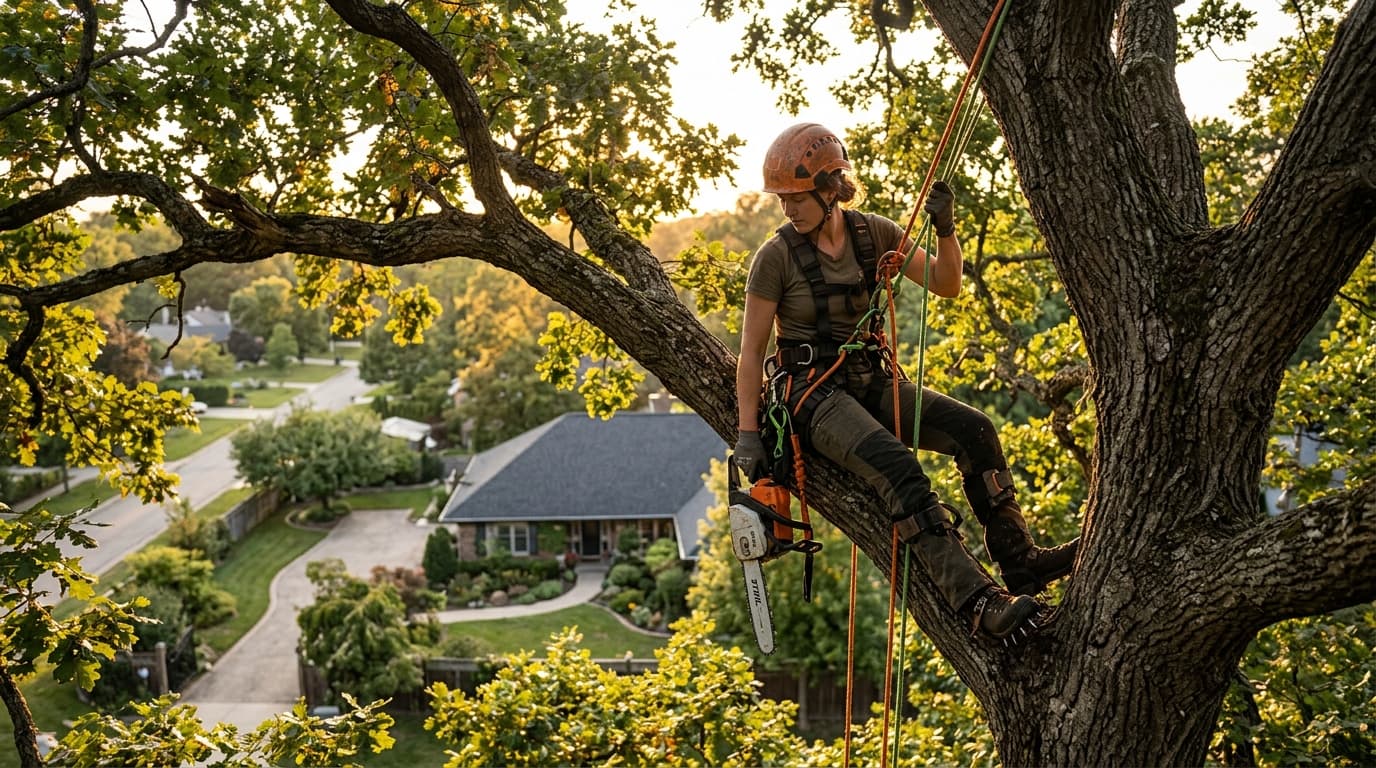
Difficult access. A tree in the back corner of a small city lot with a six-foot fence and no gate, a neighboring garage within five feet, and power lines overhead is a different job than the same tree in an open field. Equipment access changes the labor requirements, the rigging complexity, and the time.
Root proximity to utilities. If a root system runs under a gas line, removing the stump becomes a separate and careful operation. Even the removal itself requires awareness of what might be disrupted underground.
Legal or municipal requirements. Some municipalities require permits for trees over a certain diameter. Some protected species need documentation before removal. These requirements add administrative time and sometimes require a licensed arborist rather than a general tree crew.
The Pricing Framework
Most tree service pricing starts with a base rate calculation and then applies multipliers or additional charges for risk and complexity factors. Here is how to build that structure.
Base Cost Calculation
Start with the core inputs:
- Labor hours (crew size times expected hours on site)
- Equipment time (chipper, crane rental if applicable, bucket truck if applicable)
- Debris disposal
- Drive time to and from the job
- Your overhead allocation (insurance, fuel, vehicle maintenance, admin)
For a standard residential removal with no complicating factors, this gives you your floor. You should not quote below this number. If you do, you are eating cost somewhere.
Risk Multipliers
For each complicating factor, add a percentage or flat fee:
Structural proximity. For trees within 10 feet of a structure, add 25-40% to reflect the rigging and spotting requirements. Within five feet, consider whether the job needs a crane and price accordingly.
Power line proximity. If the utility company needs to be involved, get their cost and pass it through with a coordination fee. If you are working around live lines independently, the premium should be significant. This is where injuries happen.
Dead or compromised wood. Add 20-35% for trees with significant dead wood. The unpredictability requires slower, more careful work and more communication on the ground.
Access constraints. If equipment cannot get to the tree, you are rigging and lowering sections by hand. Estimate the additional labor honestly. A job that takes four hours with a chipper truck accessible might take seven without it.
Emergency response. Emergency tree services cost 1.5 to 3 times standard rates. If you are responding to a storm-damage call on a weekend, those numbers are real. Do not discount emergency calls to win the business. The demand is there, the risk is higher, and your availability has a value.
Stump Grinding
Stump grinding is a separate line item. Most operators quote it that way and let the customer decide. The typical range for stump removal runs $75 to $300 depending on the diameter and root complexity. Quote it as an add-on, not included, and let the customer opt in.
Explaining the Price Without Losing the Job
The hardest part of tree service pricing on dangerous removals is not calculating the number. It is explaining it to a customer who is comparing you to the guy who gave them a quote for $400 less.
Here is what works:
Show your work on the risk factors. Walk the customer through the specific reasons this job costs what it costs. The branch that hangs over the roof. The dead wood above the fence. The access situation that prevents using the chipper truck. When customers understand why the job is complicated, they are more willing to pay for the expertise to do it safely.
Talk about liability. This is a conversation most contractors avoid, but customers respond to it. "If that branch comes down on your roof, we are both dealing with a problem. That is why we build extra time into the rigging on this job." Most homeowners have not thought about what happens if the removal goes wrong. Helping them think about it shifts the conversation from price to protection.
Anchor to what they are protecting. A roof replacement costs $15,000 to $40,000. A fence replacement costs $3,000 to $8,000. The power line situation, if mishandled, can shut down a neighborhood and generate a utility claim. When you price a dangerous removal at $2,400 and the alternative risk is a $20,000 roof claim, the math looks different.
Do not apologize for your price. The contractors who lose jobs on price often communicate uncertainty about their own numbers. Quote confidently. If you have done the risk assessment honestly, your price is right. Not every customer is the right customer.
Building Estimates That Scale
If you are quoting tree jobs in your head and producing a single-number estimate, you are leaving money on the table and creating problems for yourself.
A written estimate that breaks down the work protects you. If a customer questions the price, you can walk through each line. If the job changes scope on-site (the stump is larger than expected, there is a second tree in worse shape), you have a documented baseline to justify a change order.
Your estimate should include:
- Tree count and size (height, approximate trunk diameter)
- Specific access and site conditions noted
- Risk factors identified
- Work included: removal, chipping, haul-away, stump treatment
- Work not included: utility coordination, permit fees, additional trees discovered
- Payment terms
- Expiration date on the quote
The expiration date matters more than most operators realize. Lumber prices, fuel costs, and crew availability change. A quote you gave six months ago does not reflect your current costs. Put 30 days on every quote and stick to it.
How Bit & Grain Helps
Bit & Grain for tree service operators gives you an estimating and invoicing system that works the way tree service pricing actually works, not the way a generic contractor app thinks it should.
The estimates and invoicing feature lets you build detailed, line-item quotes quickly. You can include your standard removal rates, add risk factors as line items with their own pricing, attach stump grinding as an optional add-on, and send the estimate to the customer for digital approval. When they sign, the approved estimate becomes the invoice foundation. No re-keying, no scope disputes based on a vague quote.
Grain AI can help you build estimates faster. Describe the job, the tree size, the site conditions, and the specific hazards, and get a draft quote to review and adjust. You are not starting from scratch on every quote. You are reviewing and refining, which is faster and produces more consistent pricing.
Job history is also stored by customer, so when a customer calls back a year later about a different tree, you have notes from the previous visit. You know the access situation, you know what equipment you used, and you know what you charged. That context is worth money on the follow-up quote.
All of this at $29 a month, flat. Solo operator or five-person crew, same price.
When to Walk Away From a Job
Not every tree removal is a job you should take. This is uncomfortable to say and harder to act on, especially when you need the revenue. But some jobs carry risk levels that no pricing adjustment can adequately compensate.
The situations worth turning down:
Live power lines that cannot be managed. If a tree is heavily entangled with live distribution lines and the utility company will not de-energize them for your window, that job needs specialized utility line-clearance crews, not a general tree service. The wrong call here does not result in a damaged fence. It results in an electrocution.
Structural instability you cannot assess. A tree with a hollow trunk, significant root decay, or advanced fungal infection is structurally unpredictable in ways that no amount of rigging can fully compensate for. If you cannot assess the structural state of the tree well enough to have confidence in your removal plan, the right answer is an ISA-certified arborist assessment before you start, not a higher estimate.
Access situations that require equipment you do not have. A crane-required removal without a crane is a rigging job that takes five times as long and carries significantly higher risk. If the job needs a crane and renting one is not economical for this project, quote it with the crane or pass it.
Liability exposure that exceeds your insurance. Know what your policy covers and what it does not. A job near a commercial structure or utility infrastructure that could result in a claim exceeding your coverage limit is a risk profile that belongs in the pass column.
Turning down work is genuinely hard for a small operator. The customer in front of you has a problem, you have the equipment and skills, and the money would be useful. But a bad outcome on a high-risk job can cost you more than the job is worth: in repairs, in claims, in insurance premium increases, and in the time you will spend dealing with the fallout.
The best tree service operators have clear internal standards about what they will and will not take on. Writing those standards down, reviewing them with your crew, and holding them consistently is part of running a professional operation. It is also, in the long run, part of what keeps your prices where they need to be: customers who understand you turn down work you cannot do safely are customers who trust that you are pricing the work you do take on honestly.
Tree Service Pricing: The Summary
Dangerous tree removals are not standard pricing decisions. The risk is real, the liability is real, and the expertise required is specific. Your price should reflect all of that.
Build your estimates from a clear cost baseline. Apply honest risk multipliers for every complicating factor. Explain your pricing to customers by walking through the specific conditions of their job. Write it down, every time.
The operators who underprice dangerous removals do not win long-term. They either get hurt, get hit with a claim they did not price for, or burn out doing high-risk work at low-risk prices. The operators who price confidently, explain their reasoning clearly, and hold their number win the customers worth having.
Tree service pricing is where your judgment about risk and your ability to communicate that judgment turn into profit. It is worth getting right.