

How to Start a Handyman Business: The Complete 2026 Roadmap
If you can hang a door, patch drywall, swap a faucet, and fix a gate latch before lunch, people will pay you for it. That part is easy. What trips up most new owners is everything around it: what you're allowed to do without a license, what to charge, and how to keep a $150 job from turning into a free afternoon. This guide on how to start a handyman business walks through all of it, in the order it should happen.
The demand is there. The U.S. Bureau of Labor Statistics counts about 1.6 million general maintenance and repair workers in 2025, with a median wage of $49,590 a year and roughly 148,700 openings every year over the next decade. Those are mostly people who work for someone else. IBISWorld puts the U.S. handyman services industry at about $365 billion in 2026, spread across roughly 529,000 businesses. It is a trade of small shops. A one-truck shop that is easy to reach, shows up when it says it will, and sends a clean invoice can stay busy for years.
One thing sets this trade apart from plumbing or electrical: in most states there is no handyman license to go earn. Instead there's a line, set state by state, between work you can do on your own and work that needs a licensed contractor or a licensed trade. Step 2 is the most important part of this guide. Read it twice.
1. Decide What You'll Do (and What You Won't)
"Handyman" covers a lot of ground. The shops that last write down their menu before they buy a single tool, including a short list of jobs they say no to.
Common service lines for a new handyman business:
- Small repairs: sticking doors, loose handrails, squeaky floors, gate and fence fixes
- Drywall and paint touch-ups: holes, cracks, ceiling stains, a single room refresh
- Installs and assembly: TV mounts, shelves, curtain rods, grab bars, furniture
- Carpentry odds and ends: trim, baseboard, small built-ins, deck board swaps
- Caulk, grout, and tile repair: tubs, showers, backsplashes
- Punch-list work: gutters, weatherstripping, move-in and move-out fix-ups for landlords
Pick the customers that fit. Homeowners are the easy start: they call when something is annoying, they approve a price on the spot, and they pay when you leave. Landlords, property managers, and real estate agents are slower to land and worth more. They send the same kind of work again and again, and one good property manager can fill a month.
Then write the "no" list. For most new shops it includes anything that needs a permit, anything structural, and anything electrical, plumbing, or HVAC beyond simple like-for-like swaps (and in some states, even those). Saying no early keeps you out of trouble. It also gives you a referral to hand out: the licensed electrician you trust, who will send work back your way.
2. Learn Where the License Line Is in Your State
This is the gate. Get it wrong and you are looking at real fines, like the California numbers below.
Here is the plain version. Most states do not issue a "handyman license." They set a dollar limit for small jobs, and below that limit you can work without a contractor license. Above it, you need one. Alongside that limit sit a few rules that cut across everything:
- The limit counts everything. It usually includes both labor and materials, even when the customer buys the materials. Check how your state counts.
- You can't split a job. Five $1,000 invoices for one $5,000 remodel is still a $5,000 remodel. California's licensing board says a single project is a single project, however you invoice it.
- Permits end the exemption. If the work needs a building permit, the dollar limit usually stops mattering. You need a license.
- Some work always needs a licensed trade. Electrical, plumbing, and HVAC or refrigeration work typically needs the matching state license no matter how small the price. Some states also license gas work and asbestos work.
- Hiring help can end the exemption too. In California, a job under the limit still needs a license if you hire anyone to help.
What the limits look like
Here is a sample of where the line sits right now. These are examples, not your answer. Numbers change, and they changed recently in a couple of places.
- California: $1,000 for the whole project, up from $500 on January 1, 2025, when AB 2622 took effect. No permit can be required, and you can't have workers helping. If you advertise, you have to say you're not licensed. The California Contractors State License Board lists penalties for unlicensed work that include fines of up to $15,000. Plenty of guides online still say $500, which is how people get caught.
- Nevada: Work valued at less than $1,000, labor and materials included, is exempt unless other conditions apply, such as a required building permit. Nevada's State Contractors Board says plainly that it does not issue a handyman license. The statute is NRS 624.031.
- Arizona: About $1,000 in labor and materials, with no building permit required, according to Insureon's state-by-state summary. Arizona also expects exempt handymen to say so in their advertising.
- Georgia: A residential contractor license is required once a job passes $2,500 in labor and materials, through the State Licensing Board for Residential and General Contractors.
- Florida: Per the same Insureon summary, minor non-structural work like repairs, carpentry, and installs doesn't need a state license, while structural work and roofing do. Cities and counties add their own rules.
- Texas: No statewide handyman or general contractor license. Electricians and air conditioning and refrigeration contractors are licensed by the state through TDLR, and plumbers through the Texas State Board of Plumbing Examiners. Cities set their own registration rules for the rest.
- Utah: A tiered rule, with a state filing in the middle range. The guides I found disagree on the current dollar amounts (older ones say $3,000, newer ones say a higher ceiling), so look at the state's licensing division directly.
Some states set the line well below $1,000. A few leave almost no room at all. Don't assume your state looks like your neighbor's.
What always needs a licensed trade
Even if every dollar limit above is met, these jobs belong to someone with the right license in almost every state:
- Electrical beyond like-for-like swaps: new circuits, panel work, new outlets, anything behind the wall. Whether you can legally swap a light fixture or a ceiling fan on your own depends on the state. In some it's fine under the limit. In others any electrical work needs an electrician. Don't guess.
- Plumbing beyond simple fixture swaps: supply and drain line work, water heaters, anything gas.
- HVAC and refrigeration: furnaces, AC units, and refrigerant work.
- Structural work: load-bearing walls, framing changes, anything an inspector would want to see.
You can still be the person the customer calls for these. Bring in a licensed sub, let them pull their own permit under their own license, and add your markup for managing the job. You get the customer and the repeat business without the legal exposure.
The one federal rule handymen miss
If you work in homes built before 1978 and you disturb painted surfaces, the EPA's Renovation, Repair and Painting rule applies to you. Anyone paid to do that work must be certified in lead-safe work practices, and the EPA says this includes sole proprietors. As a rough guide, the trigger is more than about six square feet of painted surface indoors or twenty outdoors, and window replacement is covered no matter how small the job. Several states run their own version of the program. Painting, sanding, drilling, and demo on an older house is handyman bread and butter, so read the EPA page before you take your first paint job.
How to check your state, in order
- Search "[your state] contractor license board" and read the page on small-job or minor-work exemptions.
- Use the CareerOneStop License Finder, a U.S. Department of Labor tool that lists a state's licenses and the agency that issues each one.
- Read the SBA's licenses and permits page for the federal, state, and local layers.
- Call your city or county building department. Local business licenses and permit rules are separate from the state, and they are the ones people forget.
- Call the licensing board and ask your exact question out loud, then write down who you talked to and what they said.
Write the answer down as a one-page "yes, no, or sub it out" list for your state. Tape it inside the truck door. This is also the list you'll check before you quote.
3. Make It a Real Business: Entity, EIN, and Name
Once you know the rules, set up the business itself.
- Sole proprietorship: Simplest, and you report income on a Schedule C. The downside is that you and the business are one person. If a customer sues, your house and your truck are on the table.
- LLC: Filing fees are set by each state, so check your Secretary of State's site. It builds a legal wall between the business and your personal assets. In a trade where you're working inside other people's homes, that wall is worth the filing fee.
- EIN: Free from the IRS, and takes minutes online. You need it for a business bank account, and later for hiring.
- DBA ("doing business as"): If you operate under a name other than your legal one, file for it with your county or state. Search your state's business registry first to make sure the name is free.
The SBA's registration guide walks through each of these.
An LLC only protects you if you treat it like a separate thing. Don't run business money through your personal checking account.
4. Get Insured
Handymen work in occupied homes, around finished floors, on ladders, and near things that break. Most customers and landlords will ask for proof of insurance before you start. Some states require it as a condition of any exemption or license.
Insureon publishes median premiums for handyman businesses (updated July 2026), mostly shops with fewer than five employees:
- General liability: about $81 a month ($978 a year) with $1 million per occurrence, $2 million aggregate, and a $500 deductible. This covers damage you cause to a customer's property and injuries from your work. It's the policy most landlords and property managers want to see.
- Business owner's policy (BOP): about $105 a month, bundling general liability with property coverage.
- Workers' compensation: about $108 a month. Required by most states once you have employees, and sometimes for your own crew of one.
- Commercial auto: about $188 a month. Your personal auto policy may not cover a vehicle used for the business, so ask your agent.
Prices vary a lot by state and by what work you list, so get at least three quotes. Be honest about the work you do. A carrier can push back on a claim for work you never told them about.
A surety bond is a different thing. Some states require one for a license, and some cities require one for a local registration. The bond protects your customers, not you, and you pay a small yearly premium for it, not the full amount. Check with your own licensing board before you buy one.
Ask for a certificate of insurance and keep a copy ready to email. Property managers will ask for it on day one.
5. Set Up the Money Side
Get a business checking account, using your EIN. Run every dollar in and out of it. When tax time comes, you'll be glad you did.
Then set your payment habits before you have a customer:
- Collect when the work is done. Take a card or a payment link on the spot. Don't mail an invoice and wait.
- Take a deposit on bigger jobs. Anything with real materials (a deck repair, a bathroom refresh) should be funded before you buy lumber. Some states limit how much you can collect upfront, so check yours.
- Open supplier accounts. Once you have a track record, many supply houses and lumberyards offer trade accounts and net terms. They help your cash flow, but only if you bill the customer first.
Set aside a slice of every payment for taxes the day it lands. We'll come back to that in Step 12.
6. Set Your Rate, Then Your Prices
Plenty of new handymen charge too little. They look at what the corner handyman charges, shave $10 off, and work for wages minus their own costs. Then the truck breaks.
Start with your own costs. Here's an example with made-up numbers; swap in yours.
Say you want $5,200 a month in owner pay before taxes, and your monthly overhead is $1,800 (insurance, truck costs, phone, software, tool replacement). You need $7,000 a month in revenue. Now count your billable hours. After quoting, supply runs, cleanup, and paperwork, four billable hours a day on twenty working days is a good month: 80 hours. Divide $7,000 by 80 and your floor is $87.50 an hour, before materials. That's well above the $50 many new guys start at. To run it with your own numbers, the free Bit & Grain job cost estimator (materials, labor, markup, and tax) is a good place to start.
For a deeper walk through hourly versus flat pricing, read how much a handyman should charge per hour in 2026.
Three pricing tools every handyman needs:
- A minimum service charge. A $40 fix still costs you the trip, the setup, the cleanup, and the invoice. A common rule is to set a minimum equal to the first one or two hours of your rate. Say it before you show up.
- Flat prices for jobs you know cold. Mounting a TV, replacing a toilet seat, hanging a door. You've done these a hundred times. Quote one price, and your speed becomes your profit instead of the customer's discount.
- Time and materials for the unknown. When you can't see behind the wall, bill hours and materials with a note on what might change. Add a markup on materials to cover the shopping, hauling, and warranty on what you buy. Many guides land between 15 and 50 percent.
The paperwork that makes it stick
You'll need three documents in your first month: a way to price, an estimate and invoice you can send in minutes, and a change order form. You can build all of it yourself. Or you can start from ours.
The Handyman Business Starter Kit is $49, one payment, and the files are yours to keep. It includes a pricing calculator spreadsheet with a minimum service charge and 12 flat-priced common handyman jobs you can adjust to your own rates, an estimate and invoice spreadsheet, a change order form in Word and PDF, and a startup checklist that covers licensing (including which jobs need a licensed trade), insurance, business setup, tools, and your first 30 days. It's the paperwork from this guide, already built. Use it, edit it, put your logo on it.
7. Tools, Truck, and Startup Costs
You probably own more than you think. The question is what a business needs on top of a garage full of tools.
Startup numbers vary a lot depending on whether you need a vehicle. Jobber's startup guide plans for about $1,390 to $2,930 for the core items (tools, licenses, registration, insurance) and calls out $5,000 to $30,000 or more for a vehicle on top of that. Handyman Startup estimates $2,000 to $6,000 total if you already own a work vehicle. A bare-bones start in your own truck or SUV is real. A fully outfitted van costs a lot more.
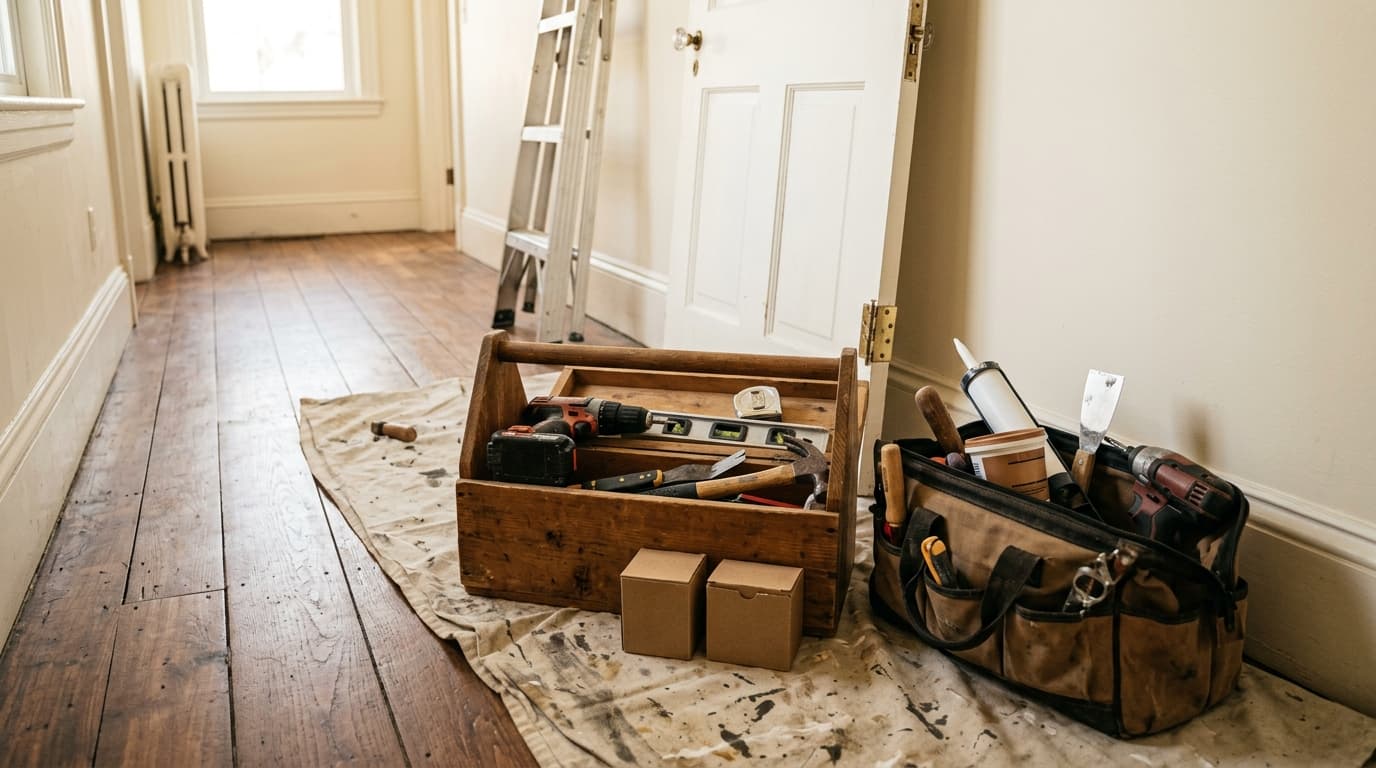
What most handyman kits need:
- Power tools: a cordless drill and impact driver, a circular saw, a jigsaw, an oscillating multitool, and extra batteries
- Hand tools: levels, tape measures, a speed square, pry bars, putty knives, a caulk gun, a stud finder, hole saws
- Basic plumbing hand tools for the fixture swaps your state allows: adjustable wrenches, channel locks, a basin wrench, a hand auger
- A non-contact voltage tester, to confirm power is off before you touch anything
- Ladders: a stepladder and an extension ladder, rated for you plus your tool belt
- Cleanup and protection: drop cloths, floor runners, a wet/dry vac, and trash bags (a clean exit sells your next job)
- Safety gear: glasses, a respirator for sanding, gloves, and knee pads
- Stock: screws, anchors, caulk, wood filler, sandpaper, and common repair parts so you can finish without a hardware store run
Buy for the jobs you've booked. A $600 tile saw can wait until the third bathroom. If you need a truck, buy used. It doesn't have to be new to make money. It has to be dependable and big enough to carry a ladder.
8. Build Your Name and Web Presence
People hire a handyman they feel they can trust. Looking real helps.
- A name and simple logo that read clearly on a truck door
- A domain name: register yours through a registrar like Namecheap or Cloudflare. It's usually $10 to $20 a year
- A business email at your domain (you@yourbusiness.com), not a personal Gmail
- A simple website with your services, your service area, your phone number, and a way to request a job
If you'd rather not build and maintain a site, Bit & Grain includes a business website and a self-booking page, so a customer can request a visit that lands in the same place you run your jobs. There's also a page on how Bit & Grain works for the handyman trade.
9. Set Up Your Operations System
Handyman work is a lot of small jobs. Twelve a week isn't unusual. Each one has an estimate, an address, a gate code, photos, a materials list, and an invoice. A notebook and a text thread will hold for your first handful of customers. After that it leaks money, quietly.
Bit & Grain is built for one-truck shops like yours. It handles estimates and invoicing, scheduling, job tracking, payments, and customer messages in one place. It's $29 a month with the Grain AI assistant included, and there's a 30-day free trial, so you can try it on real jobs before you commit. The full pricing is on one page.
What your system needs to do:
- Estimates: a clean estimate with the scope and price in writing, sent the same day you look at the job. A customer who approves a number has agreed to it.
- Invoicing and payment: send the invoice before you leave the driveway, with a way to pay right then
- Scheduling: a real calendar, with travel time between jobs built in
- Job notes: the gate code, the shutoff location, the paint color, what you quoted, what to follow up on
- A phone app on the job site: Bit & Grain has one app for iPhone, iPad, and Apple Watch, one download. Once you're parked, you can ask Grain AI to schedule a job or send an estimate by voice, with your hands on the work and not on the screen
Set this up before your first paying customer, not after you've lost track of who owes you what.
10. Get Your First Customers
You have the rules, the insurance, the tools, and the prices. Now get the phone to ring.
Google Business Profile first
Create a free Google Business Profile. It's how you show up for "handyman near me." Add your service area, your hours, the services you really do, and photos of your own work. This one listing can bring in work for years.
Ask for reviews every time
Reviews are the currency of local service work. A handyman with 40 recent reviews beats a better handyman with none. Ask after every job. Bit & Grain can text each customer a direct review link when the job closes, so you don't have to ask awkwardly at the door.
Work the people who send work
Handyman customers repeat. The best leads are people who already have a list of small jobs:
- Landlords and property managers. Turnovers, tenant calls, punch lists. Send a short email with your rates, your insurance certificate, and your service area.
- Real estate agents. They need pre-listing fix-ups and inspection-repair items done fast.
- Older homeowners who have a list of things they can't do themselves anymore.
- Neighbors. Nextdoor and local Facebook groups are free, and a post with before-and-after photos works.
Sell the half-day
"I'll be there four hours and work through your list" is an easy yes for a homeowner with eight small jobs, and a steady day for you. It's also the simplest way to price a pile of tiny things without arguing over each one.
Post your work
Take before-and-after photos and post them where your customers are. Bit & Grain connects to your social accounts, so you can schedule posts from the same place you run your jobs.
11. Run the Job Site Like a Pro
Booking is half of it. The shops that last are the ones where the customer never gets a surprise.
Scope creep is the biggest leak in this trade
"While you're here, could you also..." is the most expensive sentence a handyman hears. Each yes is a small favor, and ten of them is a lost day. The fix is a change order: a short, signed note that says what's being added and what it costs.
Quote the extra on the spot, get a signature, and add it to the invoice. The change order form in the starter kit is built for exactly that, and Bit & Grain's service log and change orders keep a record of what both sides agreed to. When the customer says "I thought that was included," you point to the page.
Communicate before, during, and after
Confirm the appointment. Text when you're on your way. Tell them early if a parts run is going to push the schedule. When you finish, send a photo of the work and the invoice. That's most of what separates a pro from a guy with a truck.
Keep the licensed-trade line in view
If a job turns into something your state says needs a license, stop. Tell the customer what you found, bring in the right licensed sub, and write it up as a change order. It costs you a conversation. Guessing costs you much more.
Take pictures
Before, during, and after photos protect you from "it was like that before you got here." They also make good posts and good proof for your next customer.
12. Track Your Money and Stay Ready for Taxes
Most new owners ignore this until April and then panic. Don't.
Track every expense
Materials, fuel, tools, insurance, software, phone, and supply-house receipts all lower your taxable income, but only if you recorded them. Bit & Grain's receipt scanning lets you snap a photo of the ticket at the counter, so it's logged by the time you're back at the truck.
Track every mile
Handymen make many short trips: to the job, to the hardware store, to the next quote. Those miles are deductible. The IRS set the 2026 business rate at 72.5 cents a mile, and then raised it for miles from July 1 (check irs.gov for the number that applies to your trips). At 15,000 business miles a year, 72.5 cents works out to $10,875 in deductions. Mileage tracking logs trips automatically, so you aren't reconstructing a year from memory in March.
Pay quarterly estimated taxes
Nobody withholds taxes from your pay anymore. As a self-employed owner you owe self-employment tax of 15.3 percent on your net earnings, on top of income tax. If you expect to owe $1,000 or more when you file, the IRS expects quarterly payments through Form 1040-ES. A safe habit is to move 25 to 30 percent of every dollar of profit into a separate savings account the day it arrives.
Ask your state revenue department how sales tax works for you. Some states tax materials you resell, and a few tax certain repair labor. It's a ten-minute call that can save a very bad surprise.
Look at your numbers monthly
Once a month, check what came in, what went out, and what's left. Bit & Grain's reporting shows this without an accounting degree, including which jobs made money.
13. Grow on Purpose
Once you're booked and profitable, grow deliberately.
- Build recurring work. Offer a yearly or quarterly "home care visit" for a flat fee: gutters, smoke detector batteries, caulk, weatherstripping, a checklist of small fixes. For landlords, offer a monthly retainer for a set number of hours. Recurring revenue smooths out slow weeks.
- Hire carefully. An employee means payroll, workers' comp, and, in some states, the end of your exemption. Check your state before you add a helper. In California, for instance, hiring any worker on a small job pulls it out of the exemption.
- Add subs. Build a short bench of licensed electricians, plumbers, and others who send work to you and take work from you. The subcontractors tools keep track of who did what.
- Consider a contractor license. If you keep hitting the dollar limit, a license opens up bigger jobs. It usually takes documented experience, an exam, and proof of insurance, so start the paperwork before you need it.
- Raise your prices. After a year of good reviews and repeat customers, move your rates up. The customers who value reliable work will stay. The ones who leave were probably your least profitable.
The Bottom Line
Learn where the license line is in your state before you take a single job. Get insured. Price from your costs, not from the competition. Get every change signed. Keep your receipts and your miles. Everything else you can learn on the job.
If you want a head start, the Handyman Business Starter Kit has the pricing calculator, the paperwork, and the checklist, and Bit & Grain can handle the estimates, invoices, scheduling, and messages once you're moving. There's a 30-day free trial, so you can try it on real jobs.
You already know how to fix things. Now go build a business around it.