
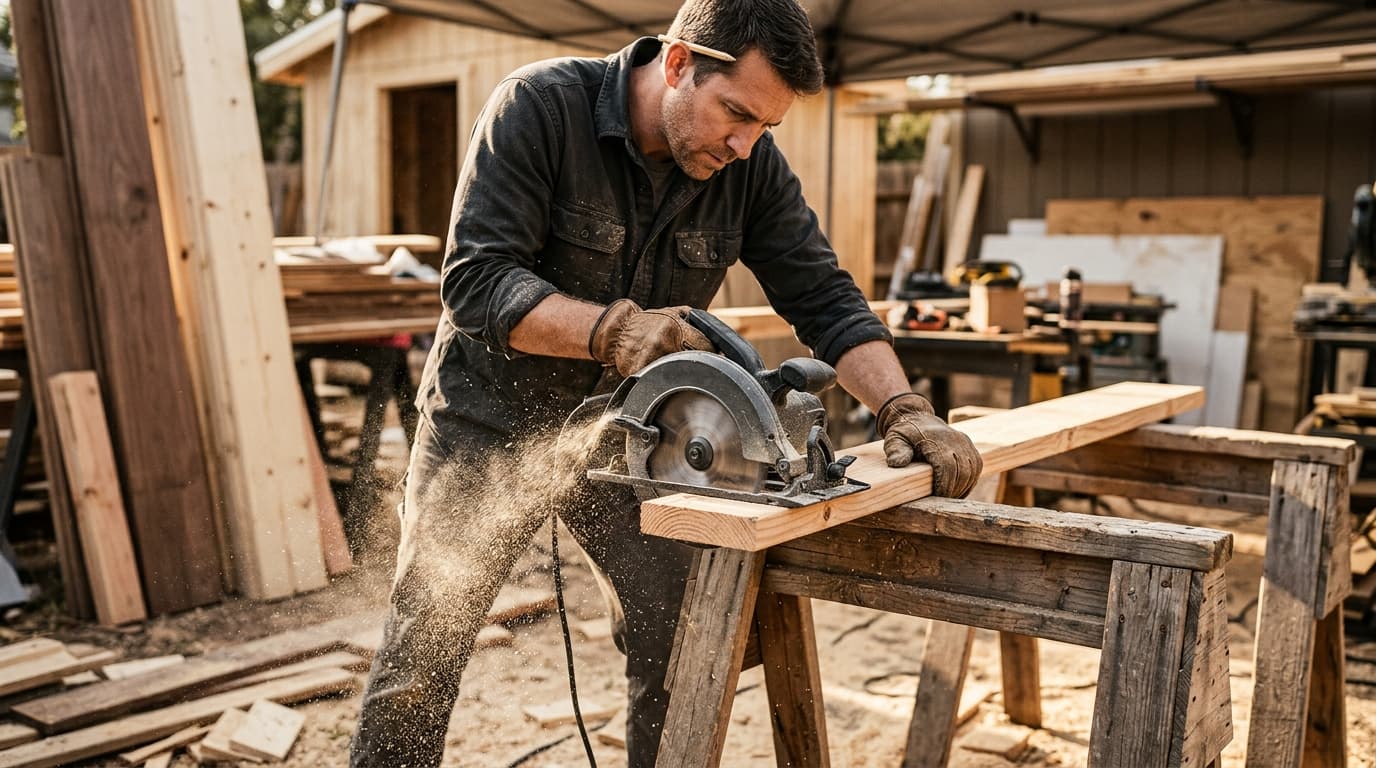

Carpentry is the trade where no two jobs are the same. One week it is a deck, the next a set of built-in shelves, then a door that will not close, then a full basement remodel. That variety is the fun of the work. It is also exactly what makes pricing so hard. There is no flat rate for "carpentry," so every quote is a fresh judgment call, and that is where a lot of good carpenters quietly lose money. Learning how to price carpentry jobs so they actually turn a profit is the difference between staying busy and staying in business.
Here is the uncomfortable part. When prices are wrong, they are almost always wrong in the same direction. McKinsey found that 80 to 90 percent of mispriced products and services are priced too low, not too high. Carpenters sit right in the middle of that. The bid felt fair, the customer said yes a little too quickly, and three jobs later you are wondering why you are working six days a week and the bank account is not moving.
Why carpenters undercharge
Undercharging is rarely one big mistake. It is a stack of small ones, and most of them come from pricing by feel instead of by math.
The most common is racing to the bottom. A customer mentions they are getting three quotes, and suddenly you are not pricing the job, you are guessing what the other two guys will say and trying to come in under them. That is not a pricing strategy. It is a way to win work you cannot afford to do.
The next is not counting all your time. You bid the hours you will spend swinging a hammer, but the job is more than that. There is the drive to the supplier and back, the time in the shop cutting and prepping, the cleanup, the punch list, the call where the customer changes their mind. None of that shows up in a "two days of labor" estimate, but all of it is time you are not getting paid for.
Then there is overhead, the cost that does not attach to any single job but has to be carried by all of them: your truck, your tools, your insurance, your phone, and the hours you spend quoting jobs you do not win. If your price does not carry a share of that, you are paying for the privilege of working. In a trade where the net margin already runs a thin 5 to 8 percent, there is not much room to absorb a mistake like that.
Price off your real numbers, not the other guy's
The fix is to build your price from the ground up, from what the job actually costs you, plus what you need to make. Three pieces.
Materials, including the waste and the small stuff
The lumber and the sheet goods are easy to count. What gets missed is everything around them: the fasteners, the glue, the caulk, the blades you dull, the sandpaper, the finish, the extra board you cut wrong. None of it is much on its own. All of it together is real money, and on a fixed-price job it comes straight out of your pocket if you did not bid it. Count the consumables, and build in a waste factor for the cuts and mistakes that are part of every real job.
Your real hourly cost, not your wage
This is the one that sinks people. The median carpenter in the US earns about $28.51 an hour as an employee, according to the Bureau of Labor Statistics. So a lot of carpenters who go out on their own figure $40 or $50 an hour sounds great, way more than they made on a crew.
It is a trap. Your shop rate is not your wage. It has to cover your wage plus the truck, the fuel, the tools, the insurance, the phone, the downtime between jobs, and the unpaid hours you spend on quotes and paperwork. By the time you load all of that in, the rate you need to charge just to take home that $28.51 is often $75, $90, sometimes well over $100 an hour, depending on your market and your overhead. Charge your wage and call it your rate, and you will be the busiest broke carpenter in town.
The margin on top
Covering your costs is not the goal. Breaking even is not a business. After the materials and the loaded labor, the price needs a margin on top, the profit that lets you weather a slow month, replace a tool, or take a week off without the lights going out. And know the difference between markup and margin, because they are not the same number. A 20 percent markup on your costs works out to about a 17 percent margin on your price. Carpenters lose real money confusing the two and then wondering why the math never quite works.
Price one job, start to finish
Say a customer wants a wall of built-in bookshelves. Here is the gut-feel version: you picture two days of work, figure a day rate of $400, call materials $600, and quote $1,400. The customer says yes fast. Feels like a win.
Now price it for real. Materials: $600 in lumber and plywood, plus another $120 in the small stuff, the screws, glue, sandpaper, finish, and a fresh blade. Call it $720. Labor: it is not two eight-hour days. It is a half day measuring and pulling materials, a day and a half of build, a half day of finish and install, and an hour of cleanup, so closer to 24 hours than 16. At a loaded rate of $85 an hour, that is about $2,040 of labor, not $800. Costs so far: $2,760. Add a 15 percent margin and your real price lands around $3,175.
So the gut quote of $1,400 was not a little low. It was less than half of what the job actually needed. You did not win that bid. You volunteered to pay the customer for the privilege of building their shelves, and you would never have known it, because $1,400 still feels like a lot of money to collect for a couple days of work.
That is the whole problem with pricing by feel. The number always sounds fine in your head. It is only when you lay out the materials, the real hours at your real rate, and a margin on top that you see how far off the gut was. Do that math once and the $3,175 stops feeling greedy. It starts feeling like the number that keeps you in business.
Build the quote from the job, then reuse it
Once you know your real costs, the quote stops being a guess and becomes arithmetic. Itemize it: materials by line, labor by the real hours, your loaded rate, your margin. It takes a little longer than scribbling a number on the back of a business card, but it does two things. It makes sure you did not forget anything, and it hands the customer a quote that looks like a professional wrote it, which is its own kind of selling.
The other win is reuse. Most carpentry work rhymes. The built-in this month is not identical to the last one, but it is close. Estimating and invoicing that lets you save and reuse line items means you are not rebuilding every quote from scratch, and the quote becomes the invoice when the job is done, so the number you agreed to is the number you bill. No retyping, no "wait, what did we say," no money lost in the gap between the quote and the invoice.
When a customer says you're too high
Price your work properly and you will hear it: "that's more than the other guy." This is the moment most carpenters fold, knock a few hundred off, and quietly give away the margin they just worked out. Do not.
A lower bid from someone else is not proof you are too expensive. It is usually proof they forgot something, the same things you used to forget: the real hours, the consumables, the overhead. The carpenter who underbids you is not beating you. He is going to find out later that he is working for free, and you do not have to join him.
When you get pushback, you have better moves than cutting the price. You can explain what is in it, the real materials and the real time, which an itemized quote makes easy. Or you can reduce the scope to fit the budget, fewer custom features, a simpler finish, so the price comes down because the work came down. What you should not do is keep the whole job and just lower the number. That is not a discount. That is you covering the customer's savings out of your own pocket.
Know what the job actually cost when it's done
Here is the step almost nobody does, and it is the one that makes every future quote better. When a job is finished, compare what you quoted to what it actually cost. Did the materials come in where you bid them? Did the labor? Did that "quick" repair eat a whole afternoon you did not charge for?
Most carpenters never run that number, so they repeat the same pricing mistakes for years. They have a vague feeling that "those built-ins are always a pain," but they never see it in dollars, so they keep underbidding them. Per-job profit and loss closes that loop. When you can see that the last three remodels all ran 20 percent over on labor, you stop guessing and start bidding the next one right. The job you already did becomes the data that prices the next one. Track it against the job as you go, and by the time you invoice, you already know whether you made money instead of hoping you did.
How Bit & Grain helps
We built Bit & Grain for carpenters who are great with their hands and tired of guessing at the money.
It helps you build a real quote off your actual materials, your loaded labor rate, and the margin you need, then turns that quote straight into the invoice so nothing slips through the cracks. It tracks what each job actually costs as you work, so when it is done you know whether the price was right, not just whether the customer was happy. And it keeps your line items and rates in one place, so the next quote takes minutes instead of an evening at the kitchen table. If you would rather talk than type, Grain AI lets you add materials or log hours to a job by voice right from the truck.
It is built for the trades, carpentry included, and it does not cost what the big platforms charge. You can see the carpentry setup and what comes included on the pricing page.
The most valuable tool you own that doesn't plug in
You did not get into carpentry to do paperwork. But the math is what keeps the doors open, and right now the odds say you are probably charging too little, because almost everyone does. The good news is that pricing is fixable, and the upside is bigger than it sounds. McKinsey found that a 1 percent increase in price, with no change in how much you sell, lifts operating profit by around 11 percent. For a carpenter, that means the gap between getting your price right and undercharging by even a little is not small. It is most of your profit.
Learning how to price carpentry jobs off your real numbers, your materials, your loaded rate, and a margin you can actually live on, is the most valuable tool you own that does not plug in. Get that part right, and you stop being the busiest broke carpenter in town. You can start free at bitandgrain.app.