
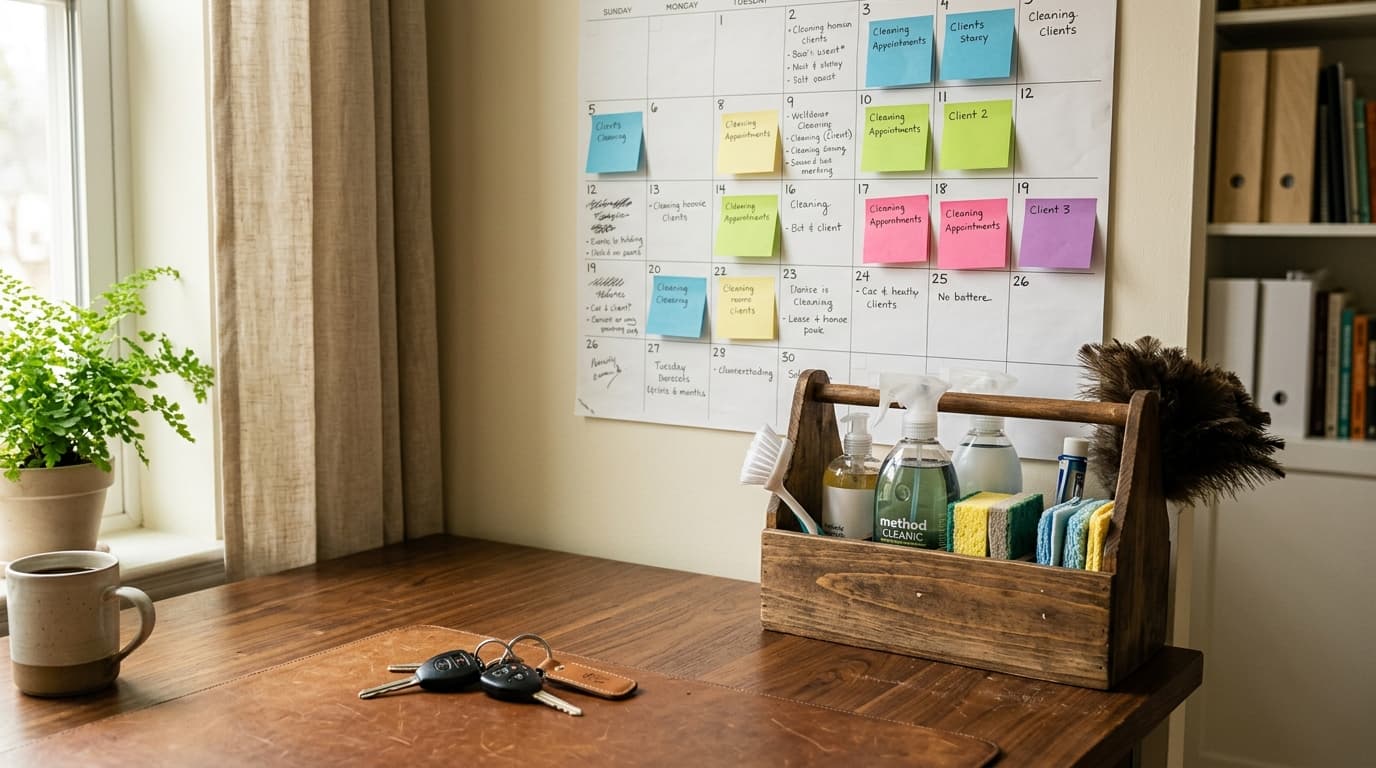

How Cleaning Businesses Build a Full Weekly Schedule from Scratch
A full weekly schedule is the goal. Not just busy, but predictably busy: the kind of schedule where you know who you're serving on Tuesday morning and Friday afternoon, weeks in advance.
Building that cleaning business schedule from scratch is where most new operators get stuck. The first few clients come from personal networks. Then what? You need a repeatable system for turning first-time customers into regular clients, filling gaps, and keeping the schedule full without spending money you don't have.
This guide covers how to build that schedule, keep it full, and stop trading time for uncertainty.
The Industry Backdrop
The US cleaning industry is one of the most fragmented markets in the trades. According to industry data, there are approximately 875,000 cleaning companies operating in the United States, with 90% employing fewer than 10 people. The janitorial services segment alone had a market size of $110 billion in 2025 (IBISWorld).
That concentration of small operators means you're not competing with Walmart. You're competing with other small operations, most of which are running lean and not particularly organized. The cleaning business that shows up professionally, communicates clearly, and makes booking easy has a structural advantage over most of the market.
Research also shows that 64% of leads for cleaning businesses come from repeat customers. A full schedule isn't built from a flood of new clients. It's built from a stable base of regulars who book predictably, week over week.
Phase One: Get Your First 10 Recurring Clients
Before you can fill a schedule, you need a foundation. Ten recurring residential clients, each booking twice a month, gives you 20 jobs per month. That's a real business.
Getting to 10 is about three things: price, availability, and personal trust.
Personal network first. The fastest path to your first clients is through people who already know you. Friends, family, neighbors, former coworkers. Tell them directly: you're building a cleaning business, you're taking on residential clients, and you'd appreciate the opportunity to quote them. Be specific. "I'm looking for five steady clients to start" is more persuasive than a vague mention that you clean houses.
Ask for referrals from day one. Every time you land a client, ask them at the end of the first clean: "If you know anyone who needs this, I'd really appreciate the referral. I'm building my schedule right now." People want to help when you ask plainly.
Nextdoor and local Facebook groups. These are free and surprisingly effective for local service businesses. Post a clear introduction: who you are, where you serve, what you offer, and how to get in touch. Not a sales pitch. A human introduction. "Hi, I'm [Name], I run a small residential cleaning service in [City]. Just starting out and looking for recurring clients. Happy to do a first clean at a reduced rate to show you what I do."
That last part, offering a discounted first clean, is your conversion tool. It's not undercutting your rates long-term. It's a demonstration. Most clients who like the first clean book again.
Phase Two: Convert First-Time Clients to Recurring Bookings
The gap between "I had a one-time clean" and "she comes every two weeks" is where most cleaning businesses lose revenue.
You close that gap by making the ask. At the end of every first clean, while the customer is seeing the results and feeling good, you say: "If you want to keep it this way, I have Tuesday mornings and Thursday afternoons available every other week. Want me to put you on the schedule?"
That's it. Give them a specific time. Make it easy to say yes.
Most clients who like your work will say yes if you make the ask concrete and immediate. If you leave and say "I'll follow up," you lose the moment. The follow-up lands when the clean is already a memory.
A client portal that lets customers book their recurring slot directly is even better. You can send them a link: "Here's where you can book your regular slot and see all your upcoming cleans." That kind of professional presentation separates you from the person who's texting back and forth trying to coordinate schedules.
Phase Three: Fill Gaps With Targeted Marketing
Once you have a base of 8-10 recurring clients, you'll have gaps in your schedule. Some weeks will be lighter. Some time slots won't fill easily.
Fill gaps strategically rather than randomly.
Ask existing clients to refer neighbors. Your clients are in houses. Their neighbors also have houses. A clean that's visible from the street (fresh windows, swept steps) is marketing. A direct ask to your client is more direct marketing: "If any of your neighbors ever need cleaning, I'd love the referral. I'm trying to fill out my [day] schedule in your neighborhood."
Clustering your schedule geographically matters. If you can do four houses on the same block on the same day, you cut drive time and make that day more profitable. Ask for referrals in specific neighborhoods where you already work.
Google Business Profile. This is free and it works. A complete profile with photos of your work, your service area listed, and real reviews from current clients will pull in local search traffic. When someone searches "house cleaner near me" in your area, you want to show up. A profile with zero reviews and no photos won't show up. One with 15 reviews and photos will.
Your website. A simple, professional website with your service areas listed and a way to request a quote is the difference between looking like a real business and looking like a Craigslist post. A proper business website doesn't need to be elaborate. It needs to tell people what you do, where you do it, and how to reach you.
According to SchedulingKit data, digital booking reduces scheduling conflicts by 45% for cleaning businesses. Making it easy to book you also makes customers more likely to book you.
Phase Four: Keep the Schedule Full by Keeping Clients Happy
Acquiring a new client costs significantly more than keeping one. The research from Bain & Company on customer retention shows that a 5% improvement in retention can raise profits by 25% to 95%.
In cleaning, client churn usually comes from one of three causes: inconsistent quality, communication gaps, or scheduling friction. Here's how to address each.
Quality consistency. Use a checklist. Not because you'll forget how to clean, but because a checklist keeps every clean at the same standard. Clients notice when something gets missed. A consistent checklist prevents that. It also trains anyone you bring on as an employee or subcontractor.
Communication gaps. Clients want to know when you're coming, when you've finished, and what to expect if something changes. Automated reminders before each clean ("Your clean is scheduled for tomorrow at 10am") and a note when you're done ("Your house is clean. See you in two weeks") are simple touches that signal professionalism. Most cleaning businesses don't do this.
Scheduling friction. If rescheduling requires a text exchange that takes two days to resolve, clients get frustrated. A scheduling system that lets clients see their upcoming appointments and reschedule when they need to removes that friction.
The Math on a Full Schedule
Let's put numbers on this. Here's what a full residential cleaning schedule looks like for a solo operator:
- 4 cleans per day
- 5 days per week
- Average clean: $150 (2-3 hours, standard home)
- That's 20 cleans per week, $3,000 per week, roughly $12,000 per month in revenue
A two-person crew running the same volume brings the revenue down slightly after labor costs but increases capacity significantly.
That's not a ceiling. It's a foundation. But it requires a full schedule. A half-full schedule with 10 recurring clients is $6,000/month. The gap between $6,000 and $12,000 is entirely about consistent client acquisition and retention: the practices above.
How Bit & Grain Helps
Bit & Grain is built for cleaning operators and other trade contractors who want to run a professional schedule without complicated software.
Scheduling. Bit & Grain's scheduling system lets you assign recurring jobs, send automated reminders, and manage your week in one place. You can see your full schedule, fill gaps, and keep everything organized without juggling multiple apps.
Client portal. Clients get a dedicated portal where they can view their schedule, see invoices, and request changes. That professional experience builds the kind of trust that keeps clients booking long-term.
Business website. A professional website tied to your Bit & Grain account means potential clients can find you, learn about your services, and request a quote directly. That online presence is what converts local search traffic into new clients.
Grain AI. Writing client messages, follow-ups, and booking confirmations is faster with AI assistance. Grain AI drafts them, you review and send. That consistency in communication is one of the things that separates retained clients from lost ones.
At $29 per month flat, Bit & Grain covers the tools you need to build and maintain a full cleaning business schedule without paying Jobber prices or dealing with per-seat fees.
What to Do When a Client Cancels
Cancellations happen. Someone moves. Someone decides to do it themselves. Someone has a financial crunch. A single cancellation isn't a problem. Recurring cancellations with no plan to backfill are.
Build a short waitlist. When you have clients who've asked about your services but you couldn't fit them in, keep their contact info. When a spot opens, your first call is to that list.
Also: when a client cancels, ask why. Not to argue. To learn. "I totally understand. Can I ask what made you decide to go in a different direction?" Sometimes it's budget. Sometimes it's scheduling. Sometimes it's something fixable. You won't know unless you ask, and occasionally you'll save the client by solving the actual problem.
If the cancellation is genuinely beyond your control, let the client know the door is open: "If you ever want to start up again, we'd love to have you back. I'll keep your preferences on file." That costs nothing and occasionally results in a client returning six months later.
Pricing That Supports a Full Schedule
One mistake that keeps cleaning businesses from filling their schedule is pricing too low out of fear. Low prices attract a certain type of client, the ones who will also be most likely to cancel or nickel-and-dime you. They also make it impossible to hire help when you need it.
Charge what your service is worth. If your market is residential and you're doing a thorough job, $120 to $200 per clean for a standard home is reasonable in most US markets. Know your numbers: travel time, supplies, time on site. Price for profitability, not just bookings.
A full schedule at $120 per clean is better than a full schedule at $80 per clean. Both are "full." Only one is sustainable.
Hire Only When the Schedule Demands It
A common mistake new cleaning operators make is hiring too soon. They get 8 clients and think they need a second person. But 8 clients at 3 hours each is 24 hours of work per week. That's manageable solo.
The right trigger for hiring is when you're turning down work because you're full. Not before. When you have a waitlist, when you're booking two weeks out, when saying yes to one new client means bumping another, that's when you hire.
Hiring too early eats your margins before you've built the revenue to support it. Waiting until the schedule demands it means your first hire goes straight into productive capacity, not overhead.
When you do hire, your systems matter even more. A scheduling system that assigns jobs, sends reminders, and tracks completions doesn't require you to be the coordination bottleneck. Your hire can see their schedule, you can see theirs, and the business runs without constant back-and-forth.
The Summary
Building a full cleaning business schedule from scratch takes time, but it has a clear path:
- Start with personal network referrals to get to 10 recurring clients
- Make the recurring booking ask at the end of every first clean
- Fill gaps by asking clients to refer neighbors in the same area
- Keep the schedule full by communicating consistently and making scheduling friction-free
The cleaning businesses that stay full aren't running complex marketing campaigns. They're showing up professionally, asking plainly, and making it easy for clients to stay. That's the whole system.
Start with Bit & Grain at $29/month and spend your time cleaning, not managing paperwork.
Bit & Grain is field service management software for trade contractors. $29/month flat. AI included. No contracts.